Research
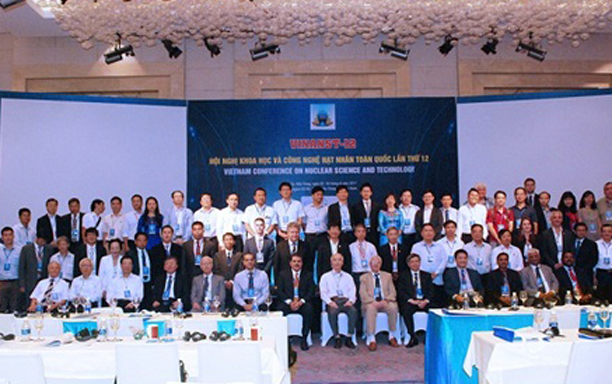
From August 2 to 4, the Vietnam Atomic Energy Institute (VINATOM), the Khanh Hoa provincial Department of Science and Technology and the Vietnam Atomic Energy Institute organized the 12th Vietnam Conference on Nuclear Science and Technology - VINANST12.
The opening was attended by Vice-Minister of Science and Technology, Mr. Pham Cong Tac, VINATOM Director, Mr. Tran Chi Thanh, the Khanh Hoa provincial People’s Committee Vice-Chairman Mr. Nguyen Duy Bac, the Khanh Hoa Department of Science and Technology Vice-Director, Ms. Le Vinh Lien Trang, and 400 researchers. Scientists and technologists came from educational institutions, officials came from Vietnamese government agencies, as well as university postgraduates and forty scientists from countries advanced in nuclear engineering, including Russia, Japan, the USA, France, South Korea, the Czech Republic, the Netherlands, Belgium, Romania, Hungary, India and Singapore.
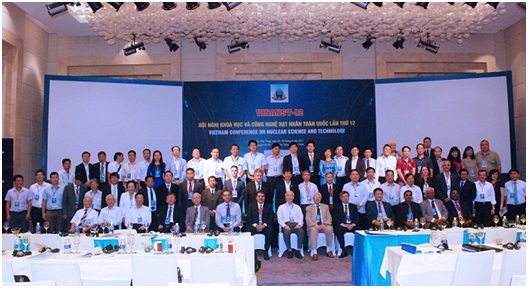
Participants
“In recent years, Vietnamese research and development, applications, and education in nuclear energy have achieved noteworthy results,” said Vice-Minister Pham Cong Tac at the opening ceremony. “However, the Vietnamese nuclear energy sector still has difficulties and challenges to meet its objectives to improve, support and exploit nuclear technology successfully to meet our country’s critical needs.”
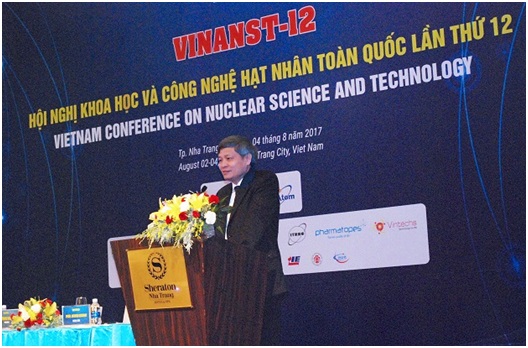
Vice-Minister of Science and Technology, Pham Cong Tac
VINATOM Director Tran Chi Thanh said, “Nuclear energy applications have been implemented over the past forty years in Vietnam, and have made many positive contributions to the socioeconomic development of our nation. Although the construction of nuclear power plants has now been halted, nuclear energy research and application development continue to receive strong support from the government. The nuclear energy sector should currently focus on developing the capacity to train specialists to research and plan the installation a nuclear center, with modern reactors, to provide an additional source of energy when the need arises, and, at the same time, research the development of other sources of alternative energy. I believe that this 12th Conference on Nuclear Science and Technology will make important contributions to meeting these objectives.”
After a review of papers submitted, the council selected 235 abstracts, 135 for oral presentation at the six technical sessions and 79 for poster presentation.
The technical sessions were:
- Section A: Nuclear Power, Nuclear Reactors and Human Resource Training
- Section B: Nuclear Physics, Nuclear Data, Accelerator and Nuclear Analysis
- Section C: Radiation Measurement, Radiation Safety and Environment Monitoring
- Sections D1-D2: Application of Nuclear Techniques in healthcare and industry
- Sections D3-D4: Radiation Technology Applications and Applications of Nuclear Techniques in Agriculture and other Areas
- Section E: Radioactive Chemistry, Nuclear Chemistry, Nuclear Material Technology, Nuclear Fuel Cycle and Radioactive Waste Management
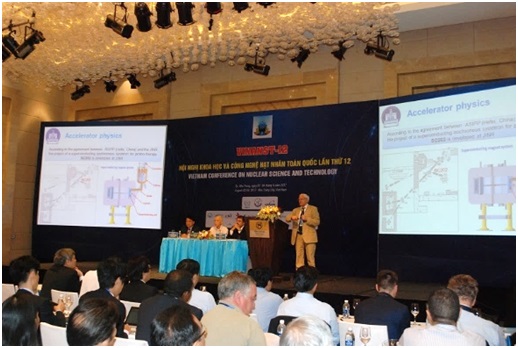
Professor Mikhail Grigorievich Itkis, of the Joint Institute for Nuclear Research (JINR), Dubna, Russia
The plenary session included 21 lectures by leading international scientists and experts from Vietnamese and foreign research institutes, universities, hospitals, and organizations active in nuclear energy. The conference also included an International Atomic Energy Agency (IAEA) workshop on “Applications of Nuclear Techniques in Industry, Agriculture and Healthcare”, with presentations by experts from the IAEA, the Czech Republic and Vietnam.
Professor Pham Duy Hien, former VINATOM Director, presented the results of analytical nuclear applications in the study of air particulate matter. Professor Mikhail Grigorievich Itkis from the Joint Institute for Nuclear Research, in Dubna, Russia, presented the latest results in nuclear research there and his future plans. Professor Boris Hippolyte, from the European Organization for Nuclear Research (CERN) in Geneva, was attending a nuclear energy conference in Vietnam for the first time, and presented the latest results in the physics of quark-gluon plasma, using ALICE at the Large Hadron Collider (LHC). This is the largest accelerator in the world, generating the highest amount of energy. It was designed to research frontal collisions between high-energy proton beams and will be used to go overcome the limitations of the Standard Model of the fundamental theory of modern particle physics. Around the perimeter of the collider are four detectors: ATLAS, CMS, LHCb and ALICE. ALICE researches several microscopic phenomena that take place in particle physics at ultrahigh energies.
Coming from North Carolina State University, in the USA, Professor Ayman Hawari currently directs North Carolina’s nuclear reactor program and is a member of the American Nuclear Society (ANS). He presented the latest information on upgrades, operations and his experience working on the PULSTAR reactor. The R-1 reactor was the first of its type to be designed, built and first operated in 1950. North Carolina now controls four nuclear reactors in three different locations.
Representing Vietnam’s agricultural sector, Professor Le Huy Ham, Director of the Agricultural Genetics Institute of the Ministry of Agriculture and Rural Development, spoke about the nuclear application of sustainable agriculture, its current status and perspectives, while Dr. Tran Duy Quy from the Institute for Asian-Pacific Science-Technology Research Cooperation (IAP) presented research on mutant rice varieties, providing a high yield, good quality and disease resistance employing nuclear technology.
Associate Professor Chung Keng Yeow, from the Singapore Nuclear Research and Safety Initiative (SNRSI), and Professor Chul Hwa Song, from the Korea Atomic Energy Research Institute (KAERI), presented their research and experiences, working on nuclear safety in Singapore and developing nuclear technology in Korea respectively. In the field of isotope hydrology, Dr. Dang Duc Nhan from the Electric Power University, in the Ministry of Industry and Trade, talked about the formation and chemistry of groundwater in the Mekong river delta.
In nuclear structure research, DTU Associate Professor Nguyen Quang Hung presented recent achievements in Vietnamese research into the level structure of atomic nuclei and his latest research has just been published in the prestigious Nuclear Physics A journal. It is based on experiments performed on the nuclear reactor in Dalat, using gamma-gamma coincidence spectrometry, demonstrating an advance in experimental nuclear physics research in Vietnam. Dr. Serge Franchoo from the IPN Orsay Nuclear Physics Institute in France presented an experimental view of the nuclear shell model today and Dr. Dimiter Balabanski, from ELI-NP, in Magurele, Romania, gave a glimpse into the future of nuclear photonics.
Professor Mai Trong Khoa, from the Bach Mai Hospital in Vietnam, talked about the application of ionizing radiation in diagnosis and cancer treatment. Vietnam has successfully applied advanced technology using ionizing radiation for cancer diagnosis and treatment. Patients benefit from these modern techniques economically and increase their chances of recovery. His team has been conducting this research for twenty years now and recently received the 2016 HCMC prize in Science and Technology. Five projects have been applied to diagnosing and treat cancer and several other conditions in Vietnam.
Dr. Najat Mokhtar of IAEA introduced their technical partnership programs supporting member in promoting nuclear energy for sustainable national socioeconomic development. Professor Misak Jozef, from the UJV nuclear research institute in the Czech Republic, talked about the essential role of nuclear power in the reduction of greenhouse gas emissions. Dr. Rui Cardoso Pereira and Dr. Sunil Sabharwal presented applications of nuclear techniques to manage harmful fly species and nuclear radiation applications respectively. Dr. Nguyen Thi Thanh Hien from the Vietnamese Plant Protection Research Institute, in Ministry of Agriculture and Rural Development, spoke in detail about controlling insects in Binh Thuan and Mr. Le Minh Tuan, from the VINATOM Development Center for Radiation Technology, presented the application of radiation technology at VINAGAMMA, focusing on achievements and future challenges in the development of radiation applications.
There was also an exhibition about publicizing nuclear research, technological applications, equipment and services for socioeconomic development. At the conclusion, reports were made on the outcome of the technical sessions and plans for future research. Associate Professor Nguyen Nhi Dien of Section A presented the following research goals:
- For nuclear power plants
+ Research nuclear safety theoretically and experimentally in two-phases, and natural convective flows by focusing on building experimental systems
+ Research small modular reactor (SMR) technology of the fourth generation using TRISO fuel
+ Continue research and the use of simulation programs to analyze neutron and hydrothermal safety, in addition to mechanical, chemical and physical processes
+ Improve the research and analysis capacity for critical incidents and accident management
- For experimental reactors:
+ Continue the design of new nuclear reactors for the Center for the Nuclear Energy Science and Technology project, focusing on safety and the efficient use of experimental reactors, flow lines, labs and so on
+ Continue research into nuclear physics, neutron physics and hydrothermics in Dalat
+ Continue efficient use of the nuclear reactor in Dalat for education and training a workforce at the new Center for Nuclear Energy Science and Technology projects
VINATOM Vice-Director Dr. Nguyen Hao Quang defined the research objectives of Section C:
+ Develop simulation and spectral splitting techniques
+ Apply radioisotopes to environmental marine research
+ Develop analytic techniques for stable isotopes for use in environmental research
+ Develop early-warning and environmental radiation status forecasting methods
In the area of health sciences in Section D1, Professor Phan Sy An presented the research and application plans as follows:
+ Enhance and expand new methods in nuclear medicine for diagnosis and treatment with PET/CT, PET/MRI, SPECT/CT, MRI and interventional X-ray techniques in the diagnosis and treatment of cancer
+ Improve and expand the range of applications of radiological techniques in clinical practice, such as diagnosis, monitoring and treatment outcome assessment and also for non-cancer patients
+ Expand the capacity to increase the quantity of medical physics research in cancer radiotherapy
+ Expand the production of new diagnostic drugs, other than FDG-F-18, for use in PET/CT
+ Improve the education and professional training of physicists working in radiotherapy and X-rays
+ A number of these proposed objectives focus on country-level research with the participation of many national domestic groups
For Sections D3-D4 “Radiation Technology Application and Application of Nuclear Techniques in Agriculture and Other Areas”, Dr. Trinh Minh Quynh presented research objectives as follows:
+ Apply radiation technology to high-performance materials with a medium-energy EB accelerator
+ Create radiation-induced mutations to select useful salinity-resistant microorganisms to mitigate the effects of climate change
+ Prepare new radiobiological products based on natural polysaccharides and nanomaterials for use in agriculture and aquaculture
The two-year research objectives of Section E are as follows:
+ Complete research into uranium processing technology and its application in metal ore processing
- Analyze and assess the environment, in particular the safety of hazardous waste storage and burial
+ Manufacture materials to dispose of radioactive and toxic waste
+ Continue the production of new rare-earth products and applying these materials to agriculture and industry in general
+ Starting research into materials for use in experimental nuclear reactors
The VINANST12 is an important event which promotes domestic scientific research and the development of nuclear energy applications in science, technology and nuclear energy applications for peaceful use.
The conference website is at: http://vinanst.vinatom.gov.vn
(Media Center)
Other News