Research

Alzheimer’s disease remains one of the most difficult neurodegenerative disorders to treat. Current therapies largely focus on slowing disease progression and reducing pathological changes in the brain, while damaged neural networks remain extremely difficult to restore.
Against this backdrop, Dr. Nguyen Minh Hung, a DTU researcher, and his collaborators conducted the study “Towards Structural Restoration: Epigenetic Reprogramming and Direct Astrocyte-to-Neuron Lineage Conversion as Next-Generation Regenerative Neurotherapeutics.” Published in Molecular Neurobiology, a Springer Nature journal (SCIE, Q1, IF 6), the study proposes a novel approach to restoring neural structures through a “three-tier neuroregeneration” model. This model combines modulation of the pathological microenvironment, the removal of epigenetic barriers, and the direct reprogramming of astrocytes into neurons.
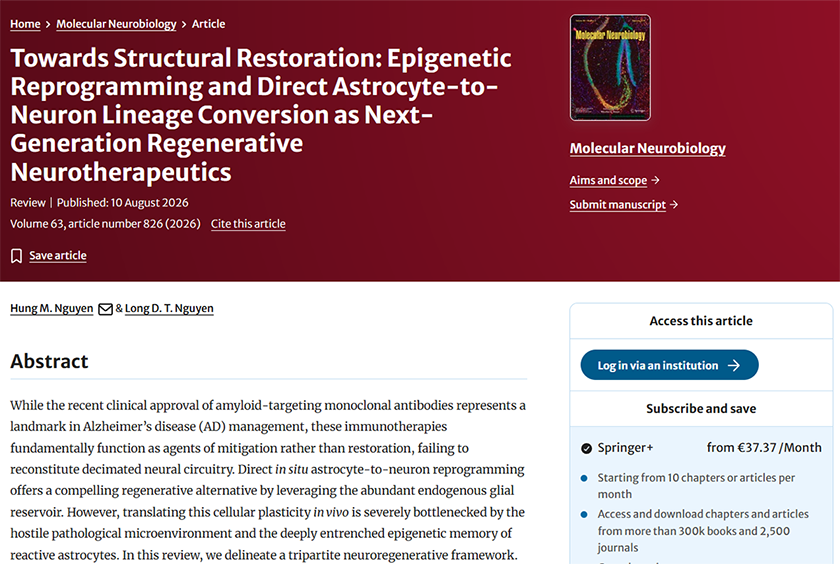
The study was published in Molecular Neurobiology (SCIE, Q1, IF 6)
Dr. Nguyen Minh Hung of the Pharmaceutical Biotechnology Center at the DTU College of Medicine and Pharmacy said: “With this study, we want to emphasize that this is not yet a cure for Alzheimer’s disease. Rather, it is an effort to broaden the scope of regenerative medicine, from asking how we can slow neuronal loss to asking whether we can create the conditions needed to restore the structure and function of neural networks. To bring this idea closer to becoming a practical therapy, many challenges must still be addressed, including safety, the precision of the reprogramming process, the ability of newly generated neurons to integrate functionally, and validation through clinical studies. We therefore view this study as a scientific roadmap for future research rather than a fully developed treatment.”
From protecting neurons to exploring neural regeneration
Anti-amyloid drugs have marked an important step forward by demonstrating that removing amyloid-β can modestly slow cognitive decline in some patients with early-stage Alzheimer’s disease. However, these therapies primarily target disease processes rather than directly rebuilding neural networks that have already been damaged.

Dr. Nguyen Minh Hung, Pharmaceutical Biotechnology Center, DTU College of Medicine and Pharmacy
This gap raises an important question for medicine: Can lost neurons be replaced and damaged neural networks rebuilt?
Alzheimer’s disease is a neurodegenerative condition characterized by cognitive decline associated with neuronal damage, synaptic loss, and the progressive breakdown of neural networks. The study’s key innovation, therefore, lies not in proposing a single drug but in combining multiple layers of biological intervention into an integrated neuroregenerative system.
Tier 1: Modifying the disease environment with senotherapeutics. Senescent cells and the inflammatory signals associated with them can create an environment unfavorable to the survival and function of newly generated neurons. The researchers therefore propose first “clearing the way” by making the brain environment more conducive to regeneration.
Tier 2: Epigenomic unlocking. Mature astrocytes carry molecular programs that preserve their cellular identity. The study identifies epigenetic mechanisms and transcriptional regulators as barriers that prevent these cells from transitioning into a neuronal state. Technologies such as CRISPR-dCas9 and epigenetic modulators are considered potential tools for reducing these barriers.
Tier 3: Cell-fate reprogramming. Transcription factors that activate neuronal programs could potentially be used to direct astrocytes toward a neuronal identity. The study stresses, however, that this process involves much more than simply changing a cell’s appearance. Successful conversion would also require coordinated changes in gene expression and energy metabolism, as well as support for the survival of newly generated neurons.
Brain-Cell Reprogramming Requires the Coordination of Multiple Molecular Factors
One of the central issues addressed in the study is that reprogramming cells in the brain cannot rely solely on activating a small number of molecular factors.
The brains of people with Alzheimer’s disease are affected by chronic inflammation, metabolic dysfunction, and damage to neural networks. Consequently, even if a new neuron can be generated, it must still survive, form appropriate synapses, and become functionally integrated into existing neural circuits.
The research team therefore emphasizes an important distinction between cells that merely display neuronal markers and neurons that can genuinely function within neural networks. One of the central issues addressed in the study is that reprogramming cells in the brain cannot rely solely on activating a small number of molecular factors.
The brains of people with Alzheimer’s disease are affected by chronic inflammation, metabolic dysfunction, and damage to neural networks. Consequently, even if a new neuron can be generated, it must still survive, form appropriate synapses, and become functionally integrated into existing neural circuits. The research team therefore emphasizes an important distinction between cells that merely display neuronal markers and neurons that can genuinely function within neural networks.
Another major challenge is the risk of converting too many astrocytes. Astrocytes are not expendable; they play critical roles in maintaining ion balance, supporting cellular metabolism, and preserving normal neural-network function. Excessive astrocyte conversion could deplete these cells and cause unintended or even harmful effects. The study therefore proposes a “selective conversion” strategy that preferentially targets pathological astrocyte populations while preserving those that continue to perform protective functions.
“We openly acknowledge the ongoing debate surrounding astrocyte-to-neuron reprogramming, particularly issues related to lineage tracing and the phenomenon of ‘pseudo-conversion,’” Dr. Nguyen Minh Hung said.
Previous studies have raised concerns about the reliability of some findings because of technical biases associated with viral vectors and the difficulty of accurately identifying the origin of cells after conversion. Confirming that a cell truly originated as an astrocyte and was successfully converted into a neuron is therefore essential before such approaches can be considered for use in humans.
From research to real-world applications: the potential roles of AI, mRNA-LNPs, and Digital Twins
Another notable aspect of the study is its effort to connect regenerative biology with emerging technologies such as mRNA-lipid nanoparticles (mRNA-LNPs), artificial intelligence (AI), and neurological digital twins (NDTs).
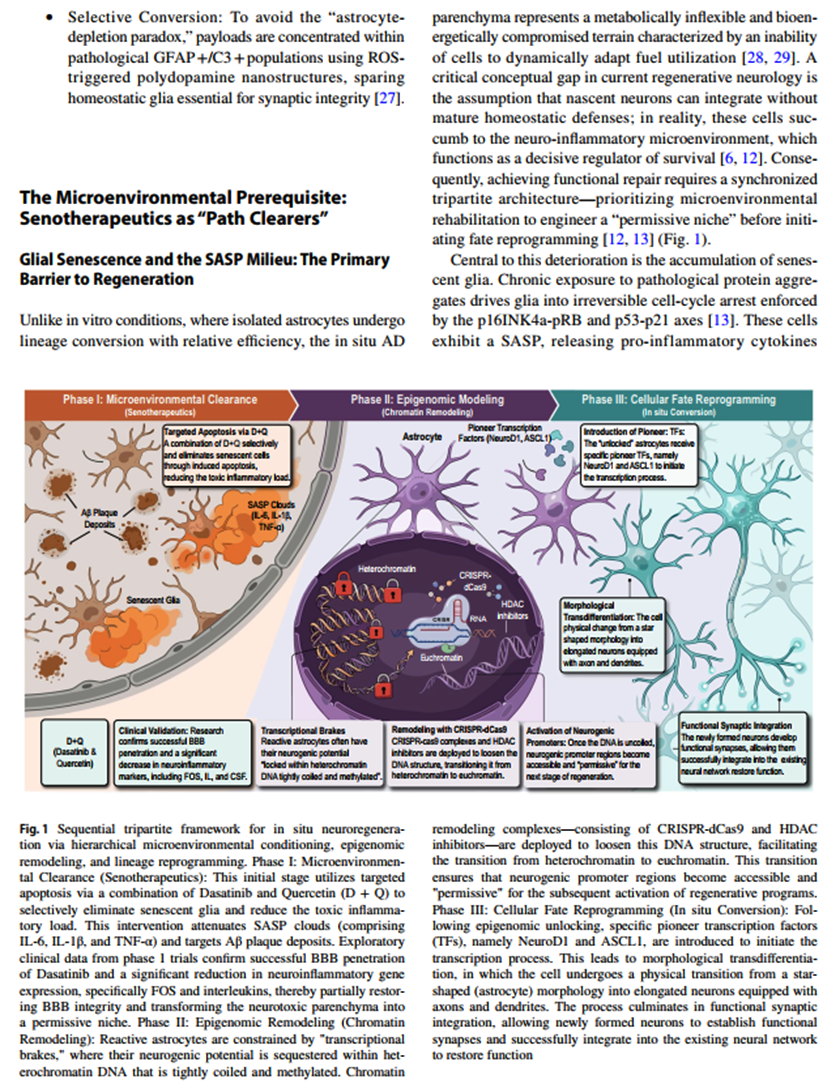
Diagram of in situ neuroregeneration through hierarchical modulation
of the microenvironment, epigenetic remodeling, and cell-lineage reprogramming
mRNA-LNPs are being considered as a potential means of temporarily delivering genetic material, which could help overcome some of the limitations associated with conventional viral vectors. The study is particularly interested in using nanoscale delivery systems to target pathological astrocyte populations more selectively rather than triggering widespread, uncontrolled cell conversion.
Meanwhile, neurological digital twins are proposed as a potential computational tool for integrating patient-specific data, simulating disease progression, and helping determine the most appropriate timing for intervention. However, the researchers emphasize that this technology is still under development and will require extensive long-term clinical validation before it can become a practical aid in treatment planning.
The immediate value of the study, therefore, is not that it offers an Alzheimer’s therapy ready for clinical use. Instead, it provides a research roadmap that can be tested step by step-from cell-based models and preclinical studies to safety evaluations, confirmation of cell origin, and assessment of whether newly generated neurons can successfully integrate into neural networks.
Research direction: Turning the theoretical framework into testable preclinical models
According to the roadmap proposed in the study, the next stage of research should focus on turning the theoretical framework into testable preclinical models.
The proposed process comprises several stages: reducing the burden of senescent cells and harmful signals; assessing whether epigenetic plasticity can be restored; carefully controlling astrocyte reprogramming; and evaluating whether newly generated neurons can functionally integrate into existing neural networks.
A guiding principle throughout this process is that safety and scientific validation must take precedence over efficacy. Future studies will need to use highly accurate lineage-tracing methods, evaluate the risks associated with astrocyte loss, assess possible disruptions to the balance between excitatory and inhibitory neural activity, and validate findings across diverse patient populations.
The study therefore offers a new way of thinking about neurodegeneration in Alzheimer’s disease. Rather than focusing solely on preventing further damage, it explores the possibility of actively restoring neural structure by combining cell biology, epigenetics, nanotechnology, AI, and personalized modeling. This is a promising research direction, but it will require rigorous scientific and clinical validation before it can be translated into real-world treatments.
(Media Center)