Undergraduate

A transparent and stable legal environment where the rights and legitimate interests of investors are protected is a fundamental pillar for building trust and to foster the sustainable development of the Vietnam International Financial Center.
At the international conference “Vietnam International Financial Center: A competitive legal framework” held by the Duy Tan University (DTU) Faculty of Law in collaboration with the University of Washington (US) and Hanoi Law University on July 3, 2026, scholars, judges, and legal experts from Vietnam and abroad presented scientific arguments and practical recommendations aimed at strengthening the legal framework for the Vietnam International Financial Center.
Distinct identity rather than copying
For the Vietnam International Financial Center to grow sustainably and be competitive on the global stage, it must be built with unique identity and strengths rather than replicating existing models.
“There are over a hundred financial centers operating worldwide, but only about 10 to 15% are considered successful, competitive, and globally influential,” explained Prof. Dr Xuan-Thao Nguyen, Director of the Asian Law Center at the University of Washington. “The primary reasons many fail to meet expectations include copying existing models, a lack of effective implementation strategies, and a lack of long-term development commitments. The difference is not determined by investment size or the generosity of incentives, but by the ability to establish and maintain a stable and transparent legal environment. Building an international financial center is a marathon, not a sprint, which is why Vietnam should selectively learn from international experience to develop a model that fits the conditions, institutions, and competitive advantages of the country.”

Prof. Dr Xuan-Thao Nguyen, Director of the Asian Law Center at the University of Washington,
and Dr Luong Ngoc Tram, Judge of the Supreme People’s Court of Vietnam (right), speaking at the conference
Conference presentations examined how to strengthen the legal framework from multiple perspectives, including comparative studies of several international financial centers and lessons for Vietnam; the role of administrative reform and shortened procedures in improving competitiveness; regulatory sandbox mechanisms to safeguard the stability of the financial system; and stronger investor protection through a clear, transparent, and effective legal framework.
“There are three possible models for developing an international financial center that Vietnam may consider,” noted Assoc. Prof. Horace Yeung, Director of Internationalization at Leicester Law School, University of Leicester (UK). “A special-jurisdiction model like the Dubai International Financial Centre or DIFC; a special economic zone focused primarily on financial and tax incentives; or a hybrid model combining elements of both. One important consideration is that the Vietnam International Financial Center should be prepared to investigate the integration of features of common law and adopt a flexible, principles-based regulatory approach. Drawing on the experience of established financial centers, Vietnam has multiple ways to achieve this goal.”
Judicial independence and dispute resolution
Judicial independence is a cornerstone of a transparent, fair, and predictable investment environment. According to the speakers, an independent and professional judiciary with fast and effective dispute resolution will contribute to the protection of the lawful rights and interests of investors, strengthening of market confidence, and the attractiveness of the Vietnam International Financial Center.
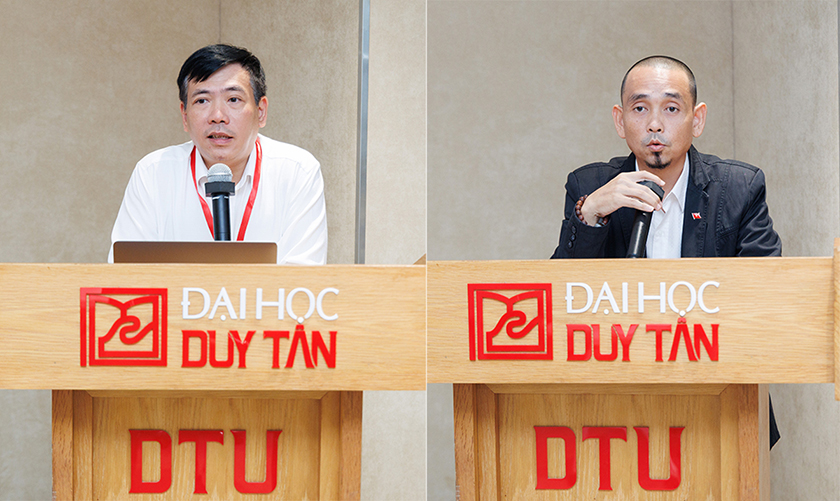
Dr Hoang Xuan Chau, Vice Rector of Hanoi Law University (left), and Dr Atty. Ho Minh Khanh,
Dean of the DTU Faculty of Law and Director of law firm MKLaw, shared their perspectives on dispute resolution
Coming from the perspective of dispute resolution, Dr Atty. Ho Minh Khanh, Dean of the DTU Faculty of Law and Director of law firm MKLaw, said that, “When investors decide to pour capital into a country, the decisive factor is not just investment incentives, but also the level of protection to property rights in the event of disputes and the effective enforcement of judgments and rulings. A dispute resolution mechanism should therefore be regarded as the ‘legal-trust infrastructure’ of an international financial center. Vietnam should continue improving its dispute-resolution framework for cross-border financial transactions and strengthen the protection of property rights and the enforcement of judgments and arbitration awards.”
From the perspective of preventing financial crime, Dr Hoang Xuan Chau, Vice Rector of Hanoi Law University, emphasized that it begins with legislative design rather than from a sole focus on dealing with violations. Designing risk control and management is considered important for preventing financial crimes, enhancing the effectiveness of supervision, and striking a balance between attracting investment and combating money laundering, financial crime, and the abuse of special regulatory mechanisms.

The international conference “Vietnam International Financial Center: A competitive legal framework” at DTU
“For a country that remains on the FATF increased-monitoring list, a credible regulatory safeguard is not a cost burden,” Dr Chau remarked, “but a prerequisite for accessing the very capital flows that the Center seeks. Imbalances must be addressed in practice, not merely declared on paper.”
Another topic that generated significant discussion was expanding the right to choose foreign law in transactions involving foreign elements. Dr Luong Ngoc Tram, Judge of the Supreme People’s Court of Vietnam, affirmed that broadening the right to choose foreign law is consistent with international integration. However, contractual autonomy must remain subject to the limits imposed by public policy and national legal sovereignty. Accordingly, courts should exercise caution when applying legal interpretation techniques to ensure maximum respect for the parties’ freedom of contract while safeguarding society’s values: mores, national security, and public order.
Training legal workforce to meet demand from Vietnam International Financial Center
In addition to strengthening institutions and mechanisms for dispute resolution, many experts opined that developing a high-quality legal workforce is essential to enhance the competitiveness of the Vietnam International Financial Center. This was regarded as the foundation for a transparent and professional environment for investment and to build trust with international investors.

Scholars, judges, and legal experts from Vietnam and abroad at the conference
“Legal professionals are the ‘soft infrastructure’ that determines the competitiveness of a Vietnam International Financial Center,” Dr Khanh stressed. “A financial center can’t rely on just investment incentives and technical infrastructure. It also requires judges, arbitrators, lawyers, and legal experts who are capable to handle cross-border transactions and disputes.
“Vietnam should move quickly to develop a strategy for training legal professionals to international standards and expand interdisciplinary education that integrates law, finance, technology, legal foreign languages, and international dispute-resolution skills.”
(Media Center)
Other News