Undergraduate
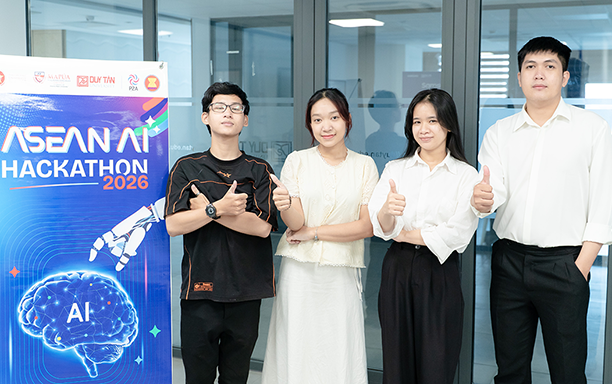
The 16 top-performing teams have advanced to the Finals of the ASEAN AI Hackathon 2026 (AAIH 2026), taking place at Duy Tan University (DTU) from August 19 to 21, 2026. The competition not only seeks outstanding ideas and innovations but also provides a platform for ASEAN’s younger generation to apply artificial intelligence (AI) to real-world challenges and develop practical solutions for their communities.
A platform connecting ASEAN’s young innovators
ASEAN is accelerating the growth of its digital economy, aiming to reach a value of US$1 trillion by 2030. This effort is expected to promote sustainable growth, strengthen regional resilience, and lay the foundation for a prosperous ASEAN in the future. Along the way, the region must also confront urgent challenges such as climate change, healthcare quality, smart urban development, and the creation of a future-ready education system.
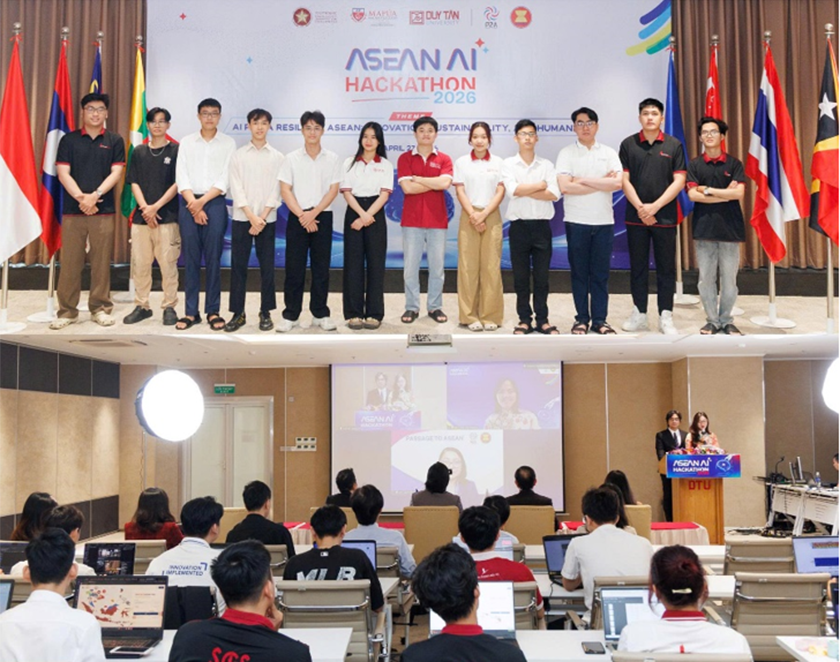
The ASEAN AI Hackathon 2026 attracted strong participation from students across the region
Co-organized by Passage to ASEAN (P2A) and the ASEAN AI Council (AAIC), the ASEAN AI Hackathon 2026 is a highly practical regional initiative designed specifically for ASEAN students. It encourages them to apply artificial intelligence to the development of innovative solutions addressing real-world problems.
Under the theme “AI for a Resilient ASEAN: Innovation, Sustainability, and Humanity,” the ASEAN AI Hackathon 2026 attracted 1,077 students on 248 teams from more than 110 universities across nine countries.
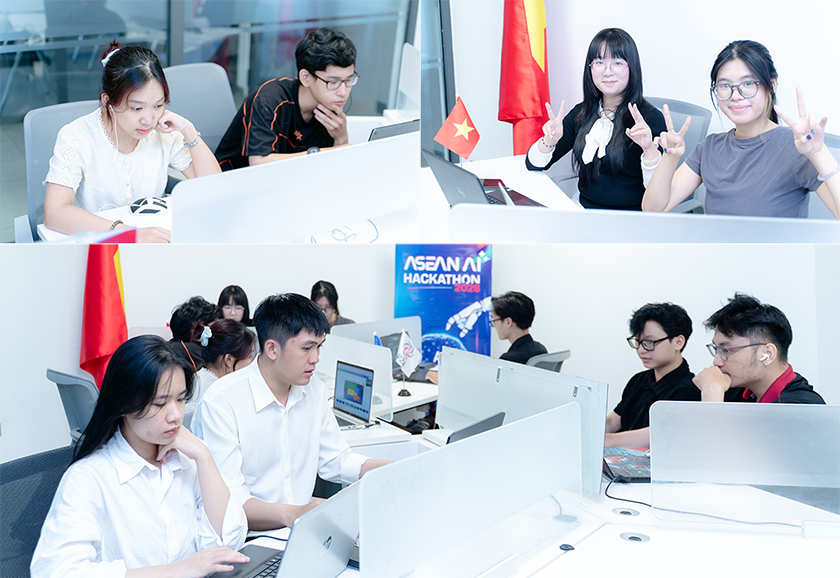
Teams focused intensely on the Semifinal round
Unlike competitions that stop at the idea-proposal stage, the ASEAN AI Hackathon requires teams to begin with real-world problems and develop their products through several stages, from initial concepts and prototypes to live demonstrations. They must also present and defend their projects before a panel of experts. What the projects share is not necessarily technological complexity, but rather feasibility and the potential for implementation under the resource-constrained conditions that remain common in many ASEAN countries.
Sixteen outstanding ideas developed by 16 teams from seven countries, including Indonesia, the Philippines, Malaysia, Thailand, Cambodia, Vietnam, and Singapore, have officially advanced to the Finals. The projects present a wide range of approaches to real-world issues in education, healthcare, the environment, and smart cities, demonstrating ASEAN youth’s creativity, ability to identify pressing problems, and determination to develop meaningful solutions.
Dr. Le Nguyen Tue Hang, Director of the Passage to ASEAN (P2A) Secretariat, DTU Vice Provost, and Chair of the Organizing Committee, said: “The theme of the ASEAN AI Hackathon 2026 is ‘AI for a Resilient ASEAN: Innovation, Sustainability, and Humanity.’ This is more than simply a theme - it is a call to action. It also provides a space for young people to learn, create, and turn their potential into meaningful real-world impact. Artificial intelligence is no longer a story of the future. AI is already here, transforming industries, reshaping society, and helping determine ASEAN’s future. The real question, therefore, is: Who will shape AI? The answer is clear: our dear students.
“We organized this competition based on a deeply held belief that, when guided by ethical values, a humanitarian spirit, and regional cooperation, AI can help us address the urgent challenges we face, from sustainable development and climate-change adaptation to economic growth and digital equity. The projects brought to this competition by students from across ASEAN can go beyond ideas to become practical solutions that benefit people, serve communities, and help shape ASEAN’s future.”
Harnessing AI to Address Shared Challenges
Ahead of the Finals, the 16 teams are entering the final phase of preparation. They are testing their products, optimizing their solutions, and refining their presentations and defenses as they prepare for an exciting competition at DTU.
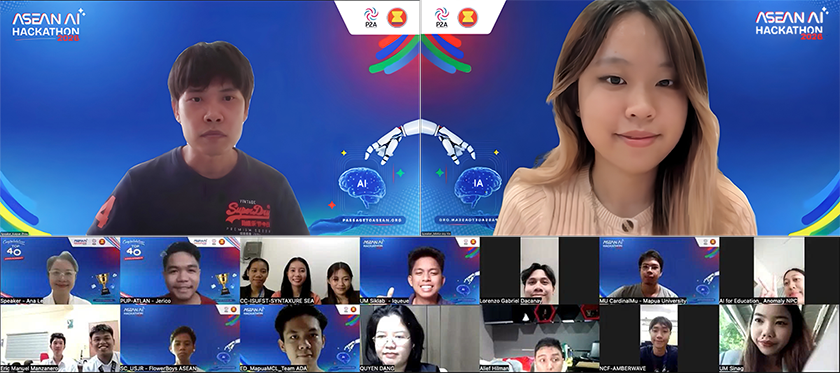
The competing teams received intensive coaching from experts
Morm Lyda, a student on the AUPP–RehabAI team from the American University of Phnom Penh, Cambodia, shared: “We are bringing ‘RehabAI’ to the competition, a web-based application that supports at-home rehabilitation. It uses MediaPipe Pose to track skeletal movements and nine XGBoost classifiers to evaluate the accuracy of physical therapy exercises. Above all, we want to ensure that no one is left behind or loses hope. Our goal is to help stroke patients who live far from rehabilitation centers gain convenient access to rehabilitation services. AI is more than just technology; it can also serve as a bridge that gives people more opportunities to transform their lives. We are truly excited and proud to have reached the Finals of the ASEAN AI Hackathon 2026. The competition has helped us realize that although each country has different circumstances and perspectives, those differences do not prevent ASEAN’s young people from joining forces to address shared challenges. We believe that by combining the creativity of young people with the power of AI, we can develop solutions that have a positive impact throughout the region.”
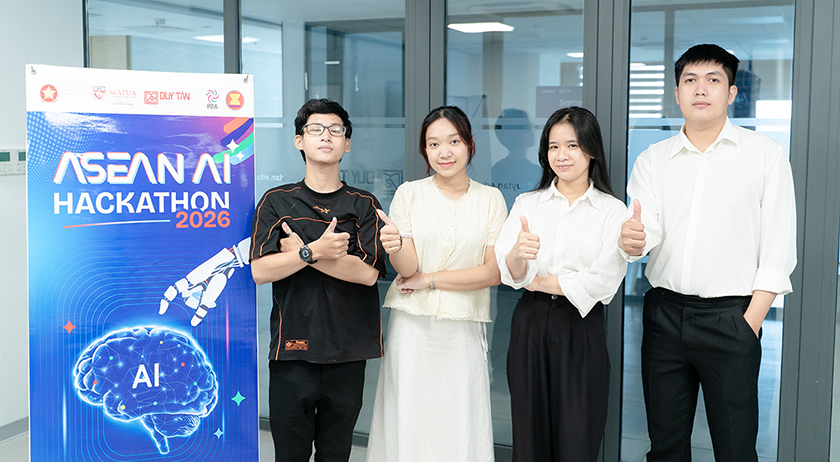
The AEGISFLOW team from DTU enthusiastically welcomes teams from ASEAN countries to the Finals
Presenting the “AegisFlowAI” project at the ASEAN AI Hackathon 2026, Nguyen Xuan Nhi, a DTU student of AEGISFLOW team, said: “The idea for our ‘AegisFlowAI’ project arose from the reality that floods frequently cause devastating losses of property and life, particularly in Central Vietnam and many other ASEAN countries. We therefore developed a system that uses the Random Forest algorithm to help predict flooding and provide early warnings, giving residents time to move their property to safety or send emergency distress signals through the system. It also recommends safe evacuation routes, helping communities respond proactively and minimize losses when floods occur.
“I am very proud to participate in a regional AI competition right here at DTU, where I study. We are delighted to welcome so many friends from ASEAN countries to the Finals, where we can share knowledge, exchange new perspectives, and learn from one another in a field we are all passionate about. More than a competition, this is an opportunity for us to overcome geographical distances and find friends and companions for our future academic and research journeys. It will also give us wonderful memories of cross-border friendships during our university years.”
During the Finals, each team will have 20 minutes to present its project, demonstrate its product or show a project video, and answer questions and defend its work before the Judging Panel. Teams must clearly highlight the real-world problem their project addresses, their AI-powered solution, its innovativeness, the technology prototype or product, its feasibility, and its potential for expansion across ASEAN.
Teams from across ASEAN are coming together at the ASEAN AI Hackathon, bringing with them different perspectives, approaches, and experiences. This diversity enables students to learn from one another, share experiences, and broaden their understanding of how AI can be applied to address similar challenges in their respective countries.
The Hackathon therefore contributes not only to the development of technological products but also to the creation of a space for intellectual exchange and cooperation among ASEAN’s younger generation, the very people who will shape how AI is developed and used throughout the region in the future.
|
The 16 outstanding teams gathering at DTU in Da Nang, Vietnam, to compete for the championship represent some of the region’s most prestigious institutions:
|
(Media Center)
Other News