Achievements
V-Nest 80, a design project aimed at rebuilding living spaces and supporting children in Nu village by the students Vo Nguyen Minh Nhat and Vo Van Duc at the School of Engineering & Technology at Duy Tan University (DTU), has outstandingly won the C-IDEA Design Award 2026 in the category architectural design.
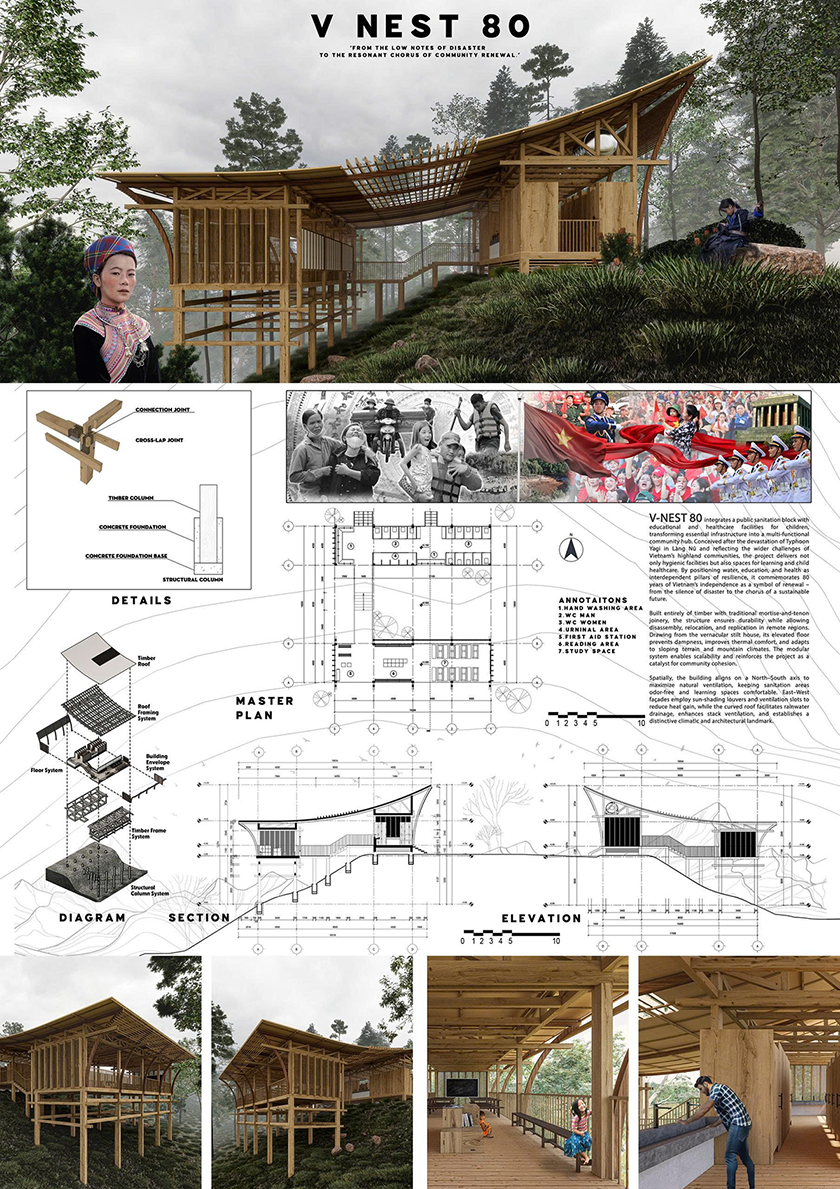
V-Nest 80 won the C-IDEA Design Award 2026 in the category architectural design - Photo courtesy of the subject
The project originated from a deep concern over the devastating losses suffered by the people of Nu village after typhoon Yagi. Under the guidance of Mr Nguyen Hoang Long, architect and lecturer at the Faculty of Architecture, the young designers worked to develop a humane architectural solution that would help the community gradually return to normal life and recover in the aftermath of the floods.
The C-IDEA Design Award 2026 is a prestigious, large-scale international design competition that brings together works from 45 countries and territories, including the US, Poland, India, Japan, China, Turkey, Germany, Spain, and Hungary.
The competition features a wide range of categories: fashion design, graphic design, photography, sculpture, interior design, book design, etc. It provides an open and diverse platform to present creative ideas and get international recognition.
A panel of 41 judges, comprising experienced and internationally renowned designers and experts, evaluate the entries. They provided diverse perspectives and enhanced the professional standards and the depth of the evaluation of the competition.
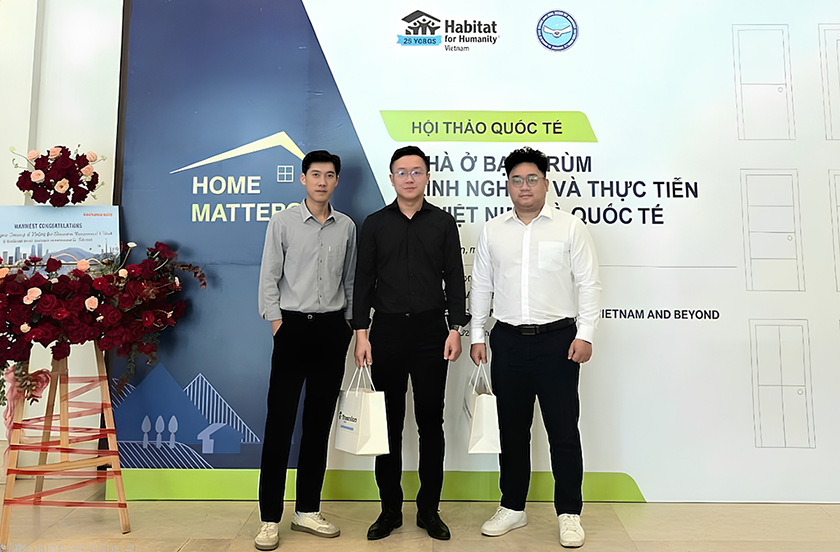
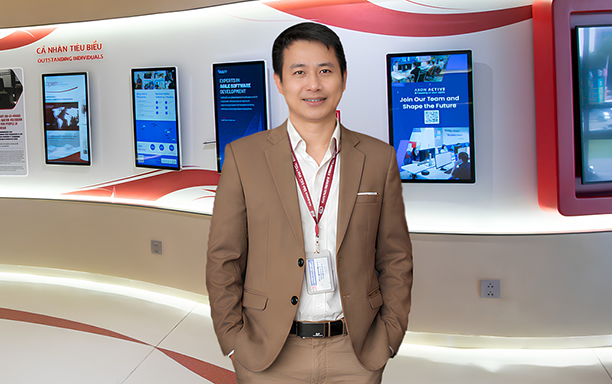
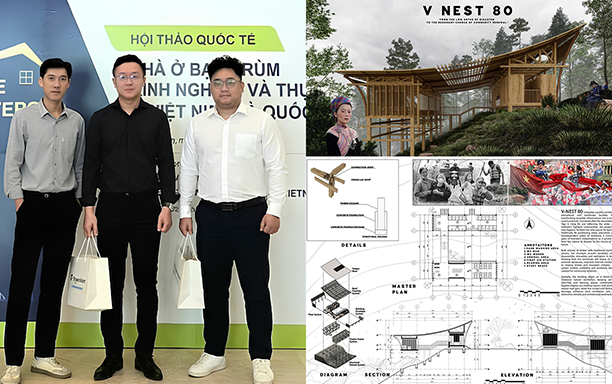
Mr Hoang Long accompanied Minh Nhat and Duc to various architecture-related activities - Photo courtesy of the subject
Design inspired by the children of Nu village
With children, one of the most vulnerable groups, at the center of its architectural solution, V-Nest 80 gradually took shape as a space that provides shelter while supporting education, healthcare, and the gradual rebuilding of community life and the well-being of children in Nu village.
“We planned V-Nest 80 on elevated terrain above steep hillsides to minimize the risk of flooding and flash floods,” Duc explains. “Respecting the natural environment, we minimized excavation and earthmoving to preserve the stability of the geological foundation.
“With lush green hillsides around, it offers a space that is close to nature where children can play, connect, and rediscover a sense of peace. This provides a natural and most effective form of psychological healing after losses.”
V-Nest 80 was highly regarded for its functionality, with a meticulously planned layout organized into three main areas for daily needs and recovery: an area for sanitation and clean water, a healthcare area, and a space for living and learning.
The space for living and learning is completely open without enclosing walls, allowing children to study while immersed in the mountain breeze. At the same time, the surrounding windows can be rapidly closed in the case of sudden storms.

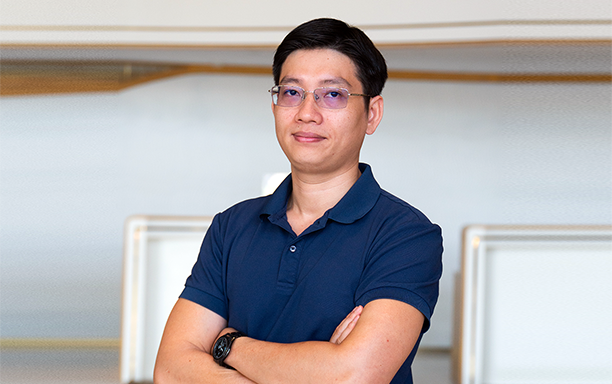
Vo Van Duc - Photo courtesy of the subject
Modern engineering built on traditional local architecture
Beyond offering a creative architectural solution, V-Nest 80, designed by DTU’s young designers, also meets strict requirements concerning engineering, aesthetics, and sustainability. The project inherits the principles of traditional local stilt houses, but “upgraded” using modern technical innovations:
Wooden columns for elevation: The structure is raised above the ground using wooden columns and beams supported by sturdy concrete foundations. This allows floodwaters to pass underneath without causing damage and also prevents moisture and insects.
Traditional timber framing: Traditional woodworking techniques using tenons and dowels minimize the need for metal screws and nails. This modular construction makes for easier assembly, dismantling, maintenance, and replacement for emergency construction following storms.
Natural ventilation and adaptive roof: A steep roof allows rainwater to drain quickly, while a stepped design creates ventilation openings along the ridge. This takes advantage of the stack effect to ventilate hot air, improve natural airflow, and enhance indoor thermal comfort.
Adaptive building envelope: The east- and west-facing sides feature adjustable wooden louvers that keep sun out but let wind in. The north- and south-facing sides are open, with extended eaves that expand views and capture cool breezes.
“As an Architecture student, I always wish to apply the knowledge I’ve gained at university, together with my own ideas, to create designs with practical value while challenging myself in international competitions such as the C-IDEA Design Award 2026,” Minh Nhat explains. “This is also the spirit of Architecture training at DTU.”

Vo Nguyen Minh Nhat - Photo courtesy of the subject
Mr Nguyen Hoang Long, architect and lecturer at the Faculty of Architecture at the DTU School of Engineering & Technology (SET), accompanied the two students in this international architecture competition. He is known for receiving several major awards: the championship title at the 2023 Asia–Pacific IDEERS contest for earthquake-resistant building design in Taiwan and first prize in Rapid Design B at the 2022 National Student Architecture Festival.
“Our team of lecturers and students evaluated V-Nest 80 from multiple perspectives: location, spatial organization, structure, materials, and adaptability to terrain and climate,” Mr Hoang Long explains. “I highly appreciate the students Vo Nguyen Minh Nhat and Vo Van Duc, not only for their creative idea, human values, and community responsibility, but also for their perseverance in taking their idea all the way to a well-founded architectural solution.
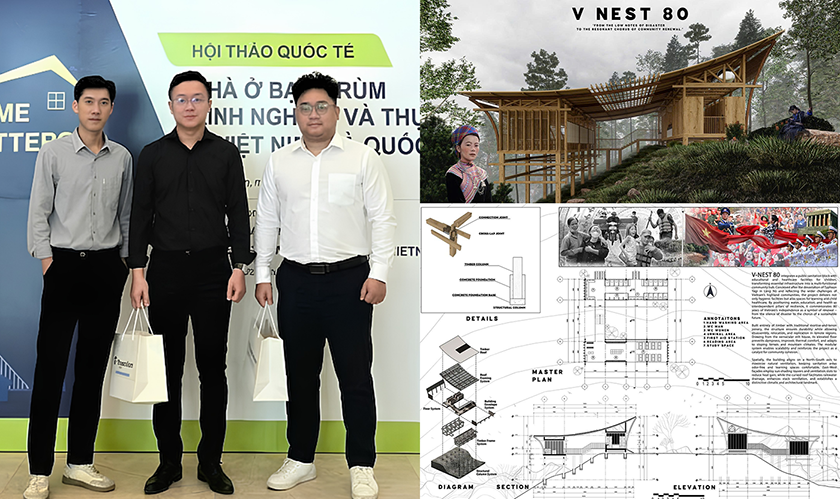
DTU students won an international award with cozy-home design for Nu village Photo courtesy of the subject
“Competing in an international contest also gave them a different kind of test beyond the Vietnamese classroom. Facing a diverse panel of judges from different countries required them to reassess their design more objectively and explain why they chose a particular solution, what problem it was intended to address, and whether it was convincing.”
(Media Center)
Other News