Achievements
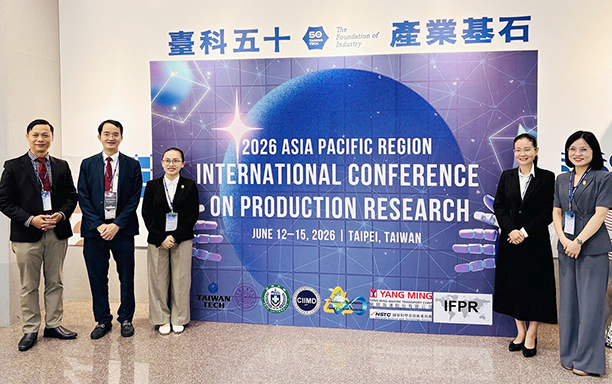
A team of lecturers from Duy Tan University (DTU) won the Best Paper Award at the 2026 International Conference on Production Research - Asia Pacific Region (ICPR-APR 2026).
Held from June 12 to 15, 2026, at the National Taiwan University of Science and Technology in Taiwan, China, ICPR-APR 2026 served as a prestigious academic forum, bringing together researchers and experts from universities, research institutes, and businesses around the world. Participants exchanged ideas and presented their latest research findings under the theme “Smart Manufacturing and Inclusive Industrialization: Towards Sustainability.”
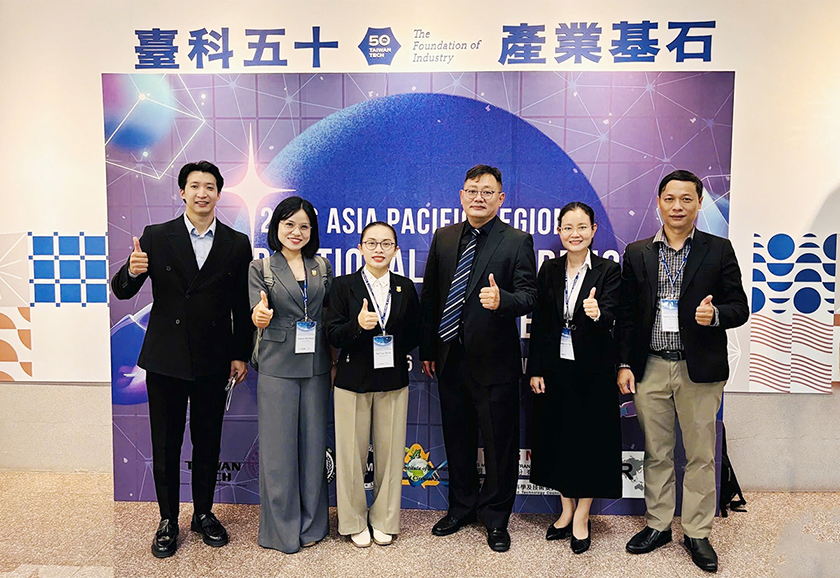
DTU lecturers pose for a photo with Prof. Dr. Ming-Lang Tseng, Chair of ICPR-APR 2026
(third from right), and other scientists and experts
The conference sought to foster networking, collaboration, and joint research among leading research groups worldwide. It also aimed to promote theoretical advances and practical applications while helping shape emerging trends in smart manufacturing and inclusive industrialization.
The DTU research team attending ICPR-APR 2026 comprised Dr. Nguyen Huy Tuan, Vice Rector of DTU’s School of Business and Economics (SBE); Dr. Nguyen Cong Minh, Head of the Graduate School; and Luu Thi Thu Huong, MSc, a PhD candidate and lecturer at the VN-US. The team presented a paper entitled “Achieving Green Competitive Advantage through GenAI: Insights from Technology-Organization-Environment-Customer (TOE-C) Resources.” The paper offered new insights into the role of Generative Artificial Intelligence (GenAI) in fostering green competitive advantage and sustainable business development.
The study examined how businesses in the tourism industry can leverage GenAI as a strategic resource to build green competitive advantages amid ongoing digital transformation and the growing demand for sustainable development.
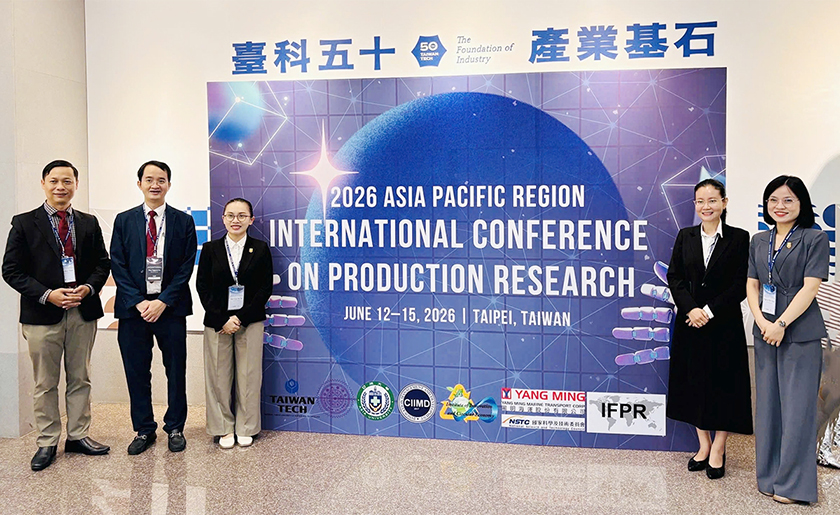
DTU lecturers and researchers attend and present their studies at ICPR-APR 2026
Rather than treating GenAI solely as a technological tool, the team examined it within the broader context of technological, organizational, and environmental resources under the Technology-Organization-Environment (TOE) framework. Based on this perspective, the researchers proposed a new model to help businesses effectively leverage GenAI to create green value and strengthen their competitiveness. In particular, the researchers expanded the traditional TOE framework by introducing a customer dimension, highlighting the role of customers in co-creating green value with businesses. The expanded framework was named TOE-C.
“To ensure a high degree of research reliability, we conducted the study in two phases and combined several methods, including text mining, the fuzzy Delphi method, exploratory factor analysis (EFA), and structural equation modeling (SEM). Data were collected from 386 business managers, enabling us to identify factors with practical relevance and rigorously test the proposed research model,” said PhD candidate Luu Thi Thu Huong.
The team encountered numerous challenges while conducting the study. The greatest was developing a research model that was both innovative and firmly grounded in theory, while remaining suitable for empirical testing in the relatively new field of GenAI. Accessing and collecting data from managers of tourism businesses also required considerable time and effort. To address these challenges, the researchers regularly consulted experts and continually reviewed and refined their model to ensure its logical coherence, practical relevance, and reliability.
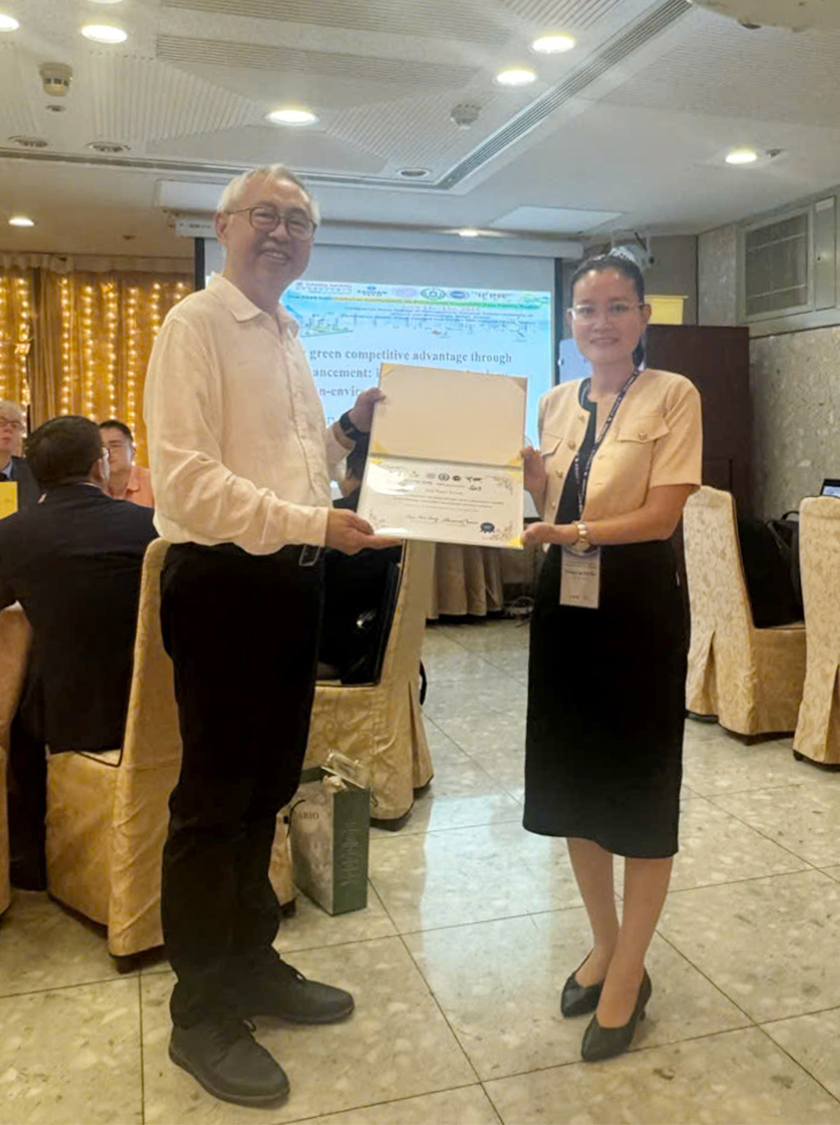
PhD candidate Luu Thi Thu Huong receives the Best Paper certificate at ICPR-APR 2026
“Building on this paper, our team is expanding its research into GenAI, digital transformation, and sustainable development in the tourism industry. We are focusing on how businesses can effectively leverage data, technology, and customer engagement to create green value. Going forward, we will conduct further empirical studies in Vietnam and other countries in the region to provide additional evidence and support the tourism industry’s green and digital transformation,” said Dr. Nguyen Cong Minh, a member of the DTU research team.
Also, at ICPR-APR 2026, Dr. Le Nguyen Bao, DTU Provost, delivered a keynote address entitled: “Agentic AI to Replace Humans in Research Process and Publications?”
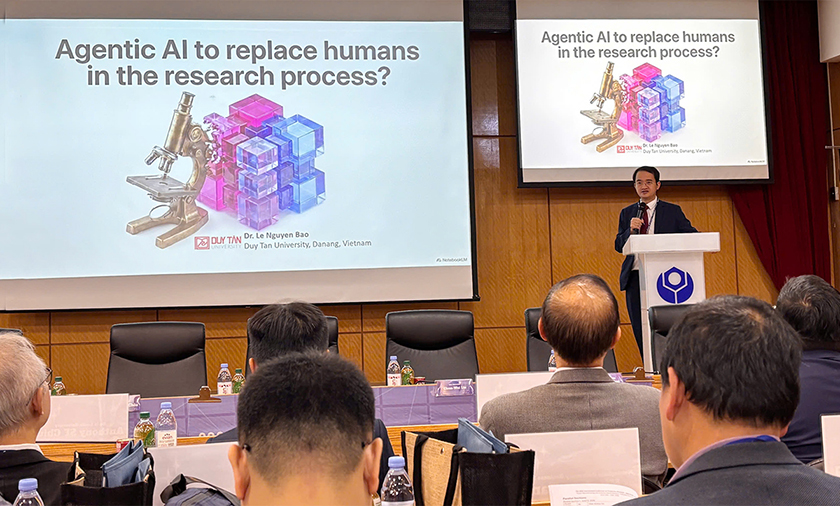
Dr. Le Nguyen Bao, DTU Provost, delivers a keynote address at the conference
Dr. Le Nguyen Bao said: “The idea of AI replacing humans in research process has always been intriguing, but whether it can partially or totally replace us remains a mind-blowing question. While all agree that it can help support our research process, few believe that it can do research all on its own. Or at the very least, even if it can do research on its own, the level of originality, integrity and creativity of subsequent publications may not be on the same par with those of humans.
An AI agent project at DTU starts to show that it can be more or less on the same par with humans in Quantitative Research while there are no clear answers for that with regard to Qualitative Research. By building smaller AI agents simulating the approach and methodologies of specific qualitative researchers and integrating them together, the quality and credibility of research output has been substantially improved. At the end of the day, the ethics in research publications remains of great controversy when the whole research process of agentic AI becomes more objective, rigorous and transparent with recognized amounts of research integrity.
In addition to the Best Paper Award-winning study, DTU presented several other papers at ICPR-APR 2026. These studies addressed topics such as ESG management in tourism supply chains, green and sustainable development, and big data analytics. They included:
- Tourism Supply Chain visibility on the firms’ ESG Capability Management: A text mining and Fuzzy Delphi Approach;
- Achieving Green Competitive Advantage through GenAI: Insights from Technology-Organization-Environment-Customer (TOE-C) resources;
- Benchmarking tourism best practices: Utilizing the big data analytics and Gen AI for sustainable performance triple bottom line, Technology Acceptance Model (TAM) and Dynamic Capability Theory (DCT);
- Developing a framework for data-driven ESG integration in Tourism Supply Chain resilience: A bibliometric and Fuzzy Delphi approach.
These achievements further underscore the research capabilities and growing international engagement of DTU’s lecturers and researchers in the fields of technology, management, and sustainable tourism.
(Media Center)
Other News