Research
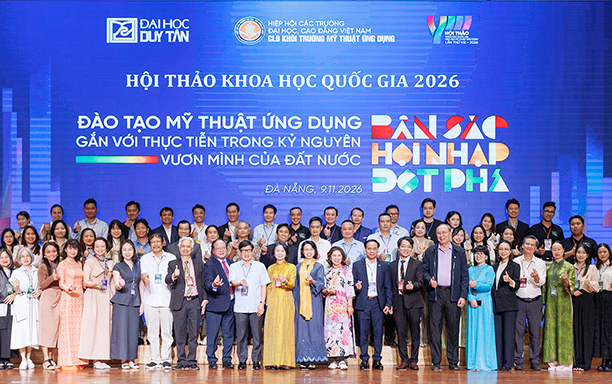
Under the theme “Applied fine-arts education tied with practice in the era of national advancement: Identity, integration, breakthrough”, the 8th National Conference on Applied Fine Arts was held at Duy Tan University (DTU) on November 9.
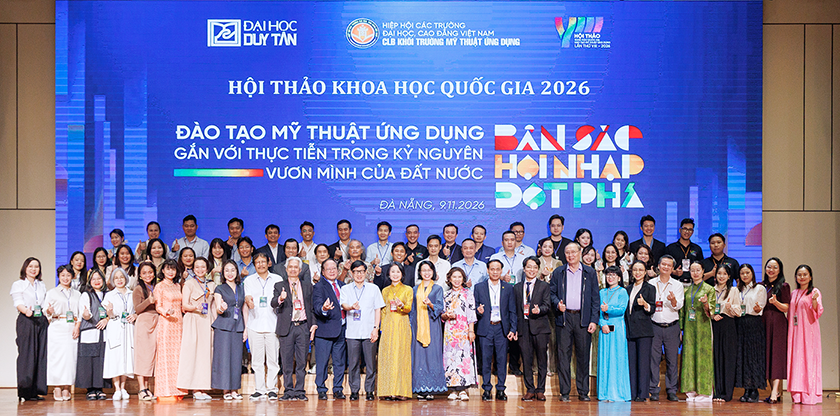
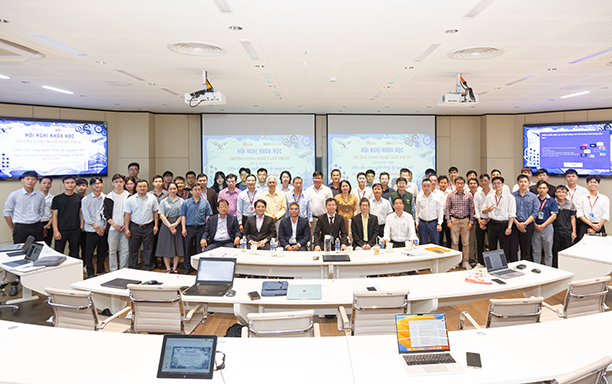
Experts, scientists, and lecturers at the conference.
DTU students also received two awards at the exhibition of applied fine-arts projects held as part of the conference.
Cultural identity and technology in contemporary design language
The conference, organized by DTU in collaboration with the Club of Applied Fine Arts Training Schools under the Association of Vietnam Universities & Colleges, attracted a large number of scientists, experts, and lecturers.
They exchanged new perspectives, shared experiences, and proposed innovative solutions for aligning applied fine-arts education more closely with practice.
Assoc. Prof. Dr. Dang Mai Anh, Chairwoman of the Club of Applied Fine Arts Training Schools, emphasized that applied fine arts demand continuous innovation and creativity. Each product must not only meet aesthetic standards but also be functional, practical, and meet the needs of contemporary life.
“This places high demands on designers,” Dr. Mai Anh said. “They must continually strengthen their specialized knowledge and improve their professional skills, interdisciplinary thinking, and creative confidence to keep up with trends, master technology, and create products with practical value and distinctive identity.”
Sharing this perspective, MA Tran Thanh Binh, Head of the Faculty of Applied Arts at the DTU School of Data & AI (SDA), said that applied fine arts should align with international integration while building on a distinctive identity. This helps establish an individual signature, proactively embrace the world’s finest creative achievements, and further enrich Vietnam’s creative values.
“As the host institution and the conference’s organizing lead, we aim not only to create a forum connecting scientists, experts, and educational institutions,” MA Binh explained, “but also to promote academic exchange, the sharing of practical experience, and the development of a design workforce that meets the development needs of the applied fine-arts sector.”
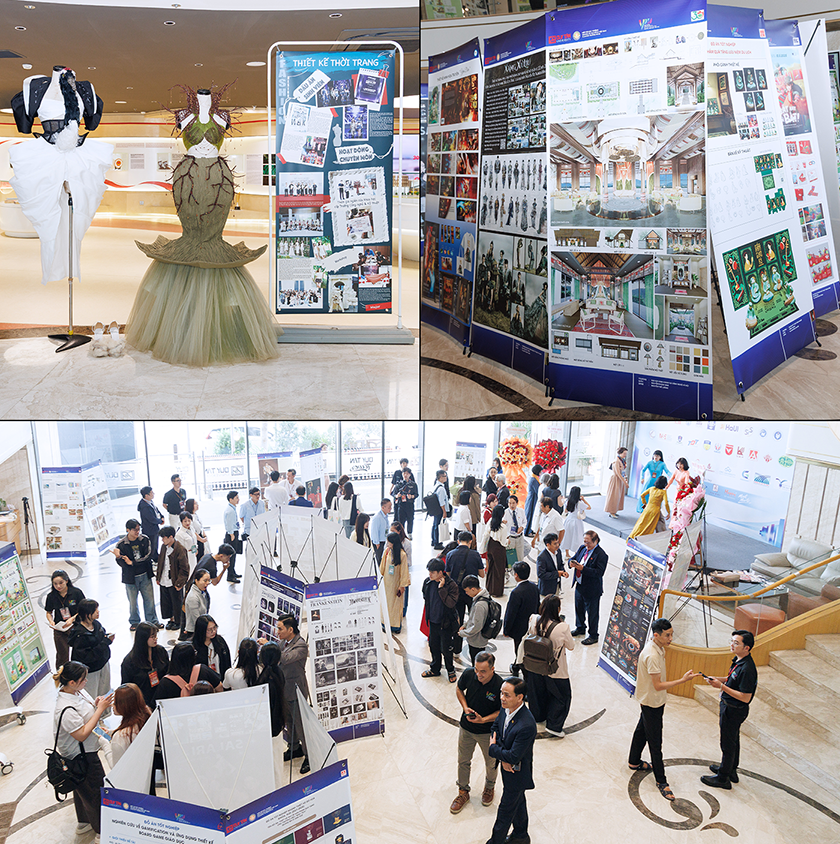
The exhibition showcased outstanding student projects from across Vietnam. Photo: DTU
Designer Nguyen Tri Phuong Dong, a visiting lecturer at DTU, delivered an online presentation from the US titled “From studio to international assessment: Twelve years of mentoring Graphic Design students at SDC Lab (2015–2026)”.
Having mentored 55 students who went on to win 91 international awards, Mr Phuong Dong shared one of his longstanding concerns: the need to establish a distinctive identity for educational programs, from aesthetic thinking and design thinking to approaches and delivery of course content, such that students acquire a solid professional foundation while developing creative thinking aligned with industry trends.
“Lecturers need to maintain connections with students and be there for them,” Mr. Phuong Dong said. “Their role goes beyond imparting knowledge to include analyzing individual designs, providing feedback, and helping with editing and refining. This way, students will recognize their limitations, improve their work, and gradually develop independent design thinking.”
The more than 140 research papers submitted to the conference focused on four subfields: graphic design, architecture & interior design, fashion design, and industrial design & media arts.
The presentations not only examined the potential of generative AI to optimize creative processes and idea development in graphic design, architecture & interior design, and fashion design, but also explored its applications in digital arts, such as 2D & 3D computer game design, music videos (MVs), and event graphics.
Many presentations also proposed ways to use AI as a powerful tool for transforming cultural heritage into contemporary products: rattan and bamboo weaving, patterns for modern ao dai, game characters inspired by folk culture, and packaging for regional specialties.
Amid the rapid development of digital technology, providing training for AI mastery hand-in-hand with professional ethics, respecting copyright, and preserving Vietnamese cultural identity has become essential to the modern design industry.
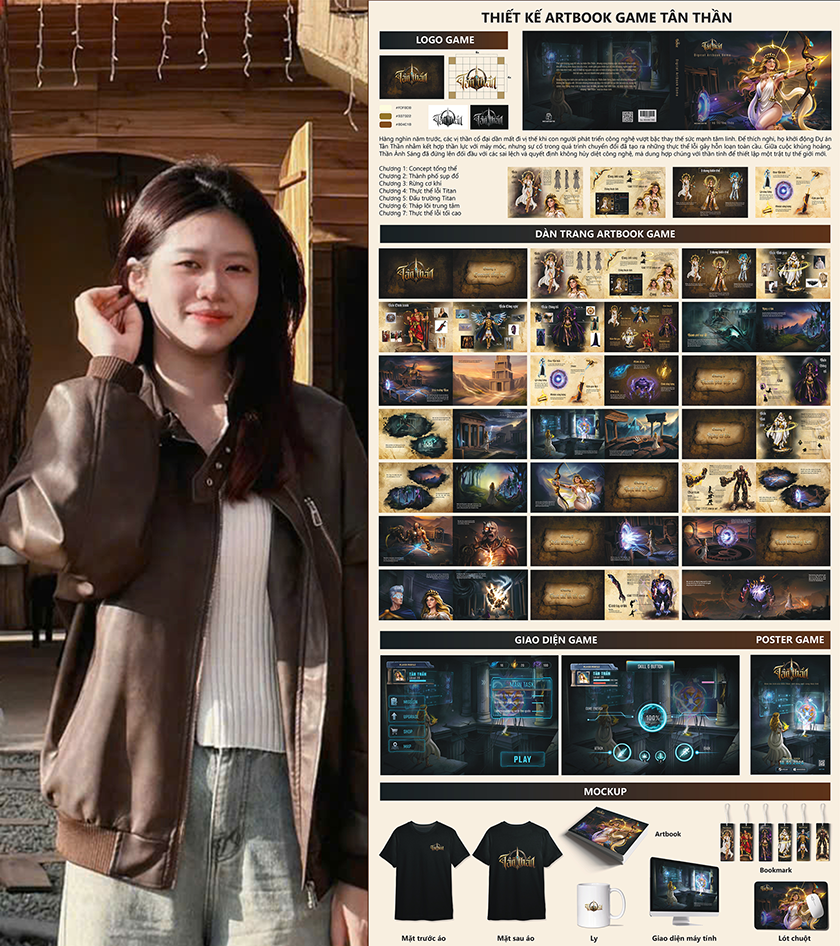
Thu Thao received the Technical Award for her Tan Than project
Technical award and outstanding cultural award for DTU students
At the exhibition of applied fine-arts projects at the conference, 38 projects from 17 universities and faculties across Vietnam were showcased. Although the projects featured different materials and presentation techniques, they all demonstrated efforts to find a distinctive design voice while renewing familiar values through the creative perspectives of youth.
DTU students received two major awards. The technical award went to “Art-book design for the computer game Tan Than” by Ho Thi Thu Thao, a Graphic Design student specializing in Digital Art Design.
Inspired by Greek mythology combined with futuristic technology, the Tan Than art book explores the intersection of mysterious, classical beauty and modernity. Through its visual elements, character designs, and color combinations, the project creates a reimagined mythological world in which Greek elements are recreated through contemporary design language.
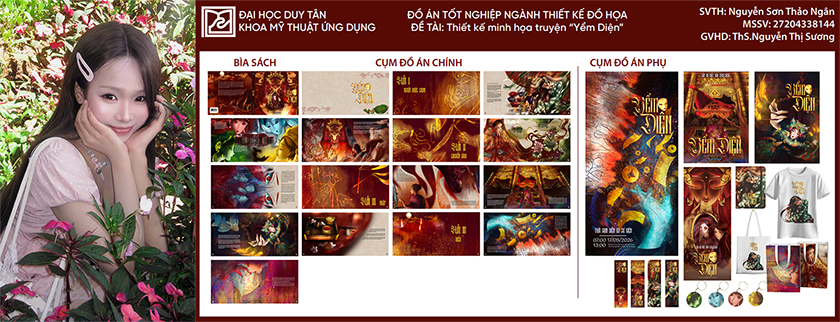
Thao Ngan received the outstanding cultural award for her Yem Dien project. Photo: DTU
The second award was the outstanding cultural award, which went to Nguyen Son Thao Ngan, a Graphic Design student, for her illustrated book project Yem Dien.
Inspired by Vietnamese mother-goddess worship and the architectural landscape of Hue from 1910 to 1925, the project recreates distinctive cultural features of this historical period in a visual language. Each image not only helps tell the story but also reflects the designer’s research and careful selection of historical, spiritual, and local cultural elements.
Thu Thao believes that design is about more than just creating visually appealing images. More importantly, it involves building a world with depth and telling a story with a distinctive identity.
“Being selected for exhibition and receiving the technical award at this major applied fine-arts event is truly a great joy and has given me greater confidence in the path I’ve chosen,” Thu Thao explains. “In addition to continuing to learn, I hope to experiment with new techniques in character design, game illustration, and technological applications to create products that reflect my own creative identity.”
Awards presented to students for outstanding projects:
- creativity award: Hon Cham Toi by a student from the University of Arts, Hue University,
- technical award: art-book design for the computer game Tan Than by a student from DTU,
- outstanding cultural award: illustrated book project Yem Dien by a student from DTU,
- concept award: illustration design for the 2D animated film Ngua Nhua by a student from the Danang University of Architecture,
- application award: launch for the Quan Khu Nam Dong book series by a student from the Hanoi Architectural University,
- innovation award: Urban art design for the Saigon welcome arch & stage axis by a student from the University of Architecture of Ho Chi Minh City,
- technology award: graphic design and promotion for the computer game The Arcade of Memories by a student from CMC University,
- breakthrough award: lacquer sculpture collection of ethnic young women by a student from the University of Industrial Fine Arts,
- identity award: art-book project Mua Nuoc Noi by a student from Mekong University.
(Media Center)
Other News