Research
On November 7, 2026, the School of Engineering & Technology (SET) at Duy Tan University (DTU) hosted its 6th Science Conference (SATNE 2026). The conference received 35 scientific submissions from 66 authors, creating a forum for academic exchange among scientists, lecturers, experts, and students across various fields of technology, engineering, and applied arts.
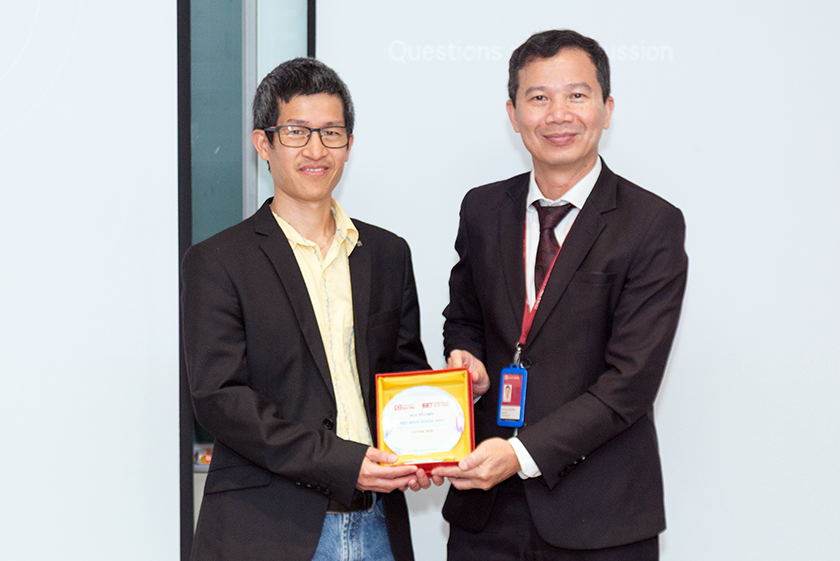
Prof. David Nguyen (left) received a souvenir from SET Provost Assoc. Prof. Dr. Ha Dac Binh
Building on the success of five previous editions, SATNE 2026 further reinforced its role as an annual scientific event organized by the DTU School of Engineering & Technology. The conference aimed to share new research findings, promote academic collaboration, and explore technological solutions with practical applications.
The conference opened with a plenary session featuring two keynote presentations by experts from Australia and Vietnam. In his presentation “From sensors to trust: IoT, 6G, AI, and cybersecurity in practice”, Prof. David Nguyen, Professor of Industry Practice at the University of New South Wales (UNSW) and Executive Chairman at N2N AI Pty Ltd Group (Australia), discussed prominent technology trends like the internet of things (IoT), sixth-generation communications networks (6G), artificial intelligence (AI), and cybersecurity. These technologies are helping shape smart connected systems while raising many research questions about data processing capabilities and information security.
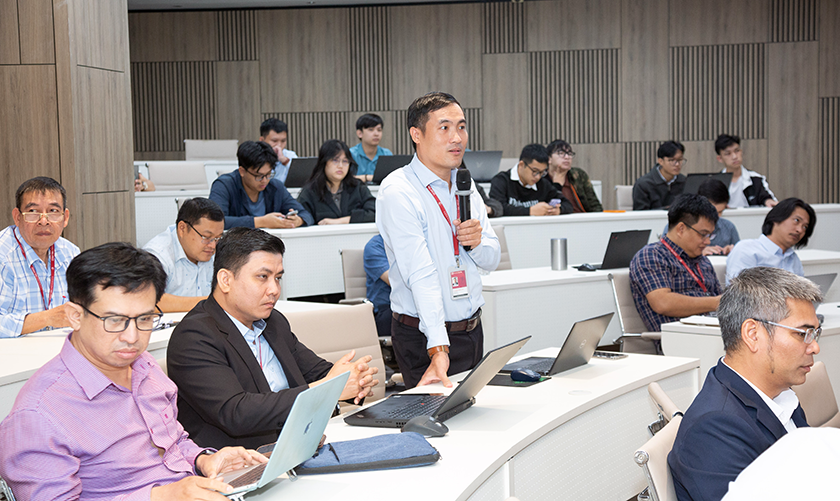
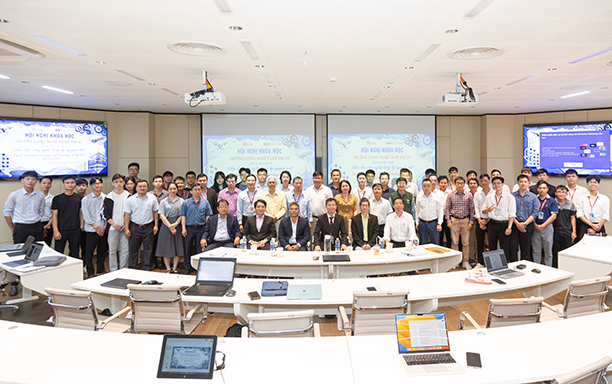
SATNE 2026 provided a forum for academic exchange among scientists,
lecturers, experts, and students across various fields of technology, engineering, and applied arts
Next, Assoc. Prof. Dr. Nguyen The Duong from the University of Technology & Education of the University of Danang delivered the presentation “Data interoperability when implementing construction projects: Practices and lessons learned”. His presentation focused on connectivity and data management in construction projects, related to the need to adopt digital technologies in today’s construction industry.
Following the plenary session, scientific presentations were delivered across three specialized sessions featuring a wide range of applied research topics.
Session 1: electrical engineering, electronics, telecommunications, automation, and robotics. Presentations focused on research related to communications technology, network security, control systems, and automation. Notable topics included IoT in the 6G era, security-performance analysis of UAV-assisted vehicular networks, the design of a rescue & emergency response vehicle controller integrated with UAV technology, quantum-key distribution in hybrid FSO/RF communication networks, and simulation of a pick-and-place robotic system using the Siemens S7-1500 PLC. These studies reflect the interest in developing smart engineering systems and expanding the practical applications of technology in industry.
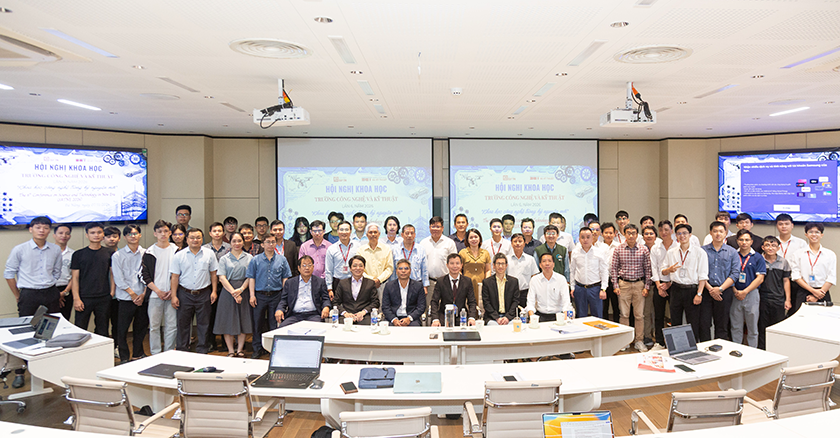
Scientists, lecturers, experts, and students at the conference
Session 2: mechanical engineering, automotive engineering technology, and materials. This session featured numerous studies related to industrial manufacturing, transportation, and healthcare. Topics included prosthetic leg design, assessment of gait biomechanics to support rehabilitation, the application of AI to optimize Ti-Ni shape-memory alloys for next-generation aircraft, and the development of ball-bearing manufacturing technologies for domestic production in Vietnam. Particularly noteworthy was a study of the effects of rear spoilers on road-holding of the VinFast VF3 electric vehicle using CFD, bringing a specific electric vehicle into engineering research.
Session 3: environment, food technology, biochemistry, natural sciences, construction, planning, architecture, and applied and other arts. This session brought together research in construction, architecture, design, and the arts. Alongside studies on BIM, construction-design appraisal, and structural safety assessment, the session also featured various applications of generative AI in training and artistic creation. Notable topics included integrating AI into the teaching of a Fashion Portfolio course, using prompt engineering to help Graphic Design students develop story concepts inspired by Vietnamese folk culture, and applying generative AI in vocal training at DTU.
At the conclusion of SATNE 2026, the organizers presented best-presentation awards to the most outstanding research projects from each session.
Session 1: “Security performance analysis of UAV-assisted ISCC vehicular networks”. This study focused on security issues in vehicular communication networks supported by unmanned aerial vehicles.
Session 2: “Assessment of gait biomechanics using pose-estimation models and foot-pressure sensors to support rehabilitation after prosthetic-limb fitting”. The study explored the application of engineering methods to gait assessment and rehabilitation support.
Session 3: “Effects of infill wall configurations on the progressive-collapse behavior of three-dimensional reinforced concrete frame–core structures”. This research provided additional scientific evidence to support the analysis and safety assessment of building structures.
With 35 talks by 66 authors, SATNE 2026 brought a diverse range of research findings in technology, engineering, and applied arts. The conference’s success further demonstrates the efforts by the DTU School of Engineering & Technology to foster an environment of scientific research, promote academic exchange, and strengthen connections between training and the demands of practical technological development.
(Media Center)
Other News