Undergraduate
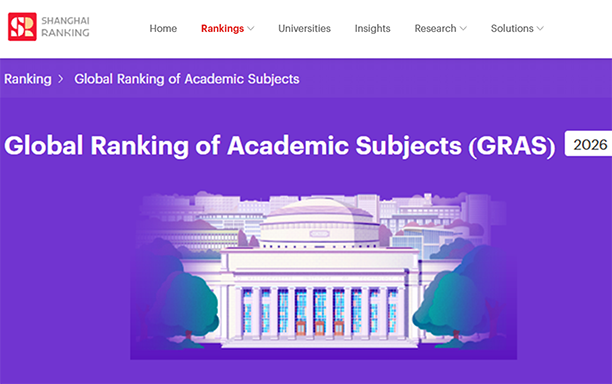
On September 15, 2026, ShanghaiRanking released their Global Ranking of Academic Subjects (GRAS) for 2026. The Vietnam National University of Agriculture returned to the rankings after a two-year absence, while Vietnam National University (VNU) Ho Chi Minh City no longer appeared in this year’s rankings.
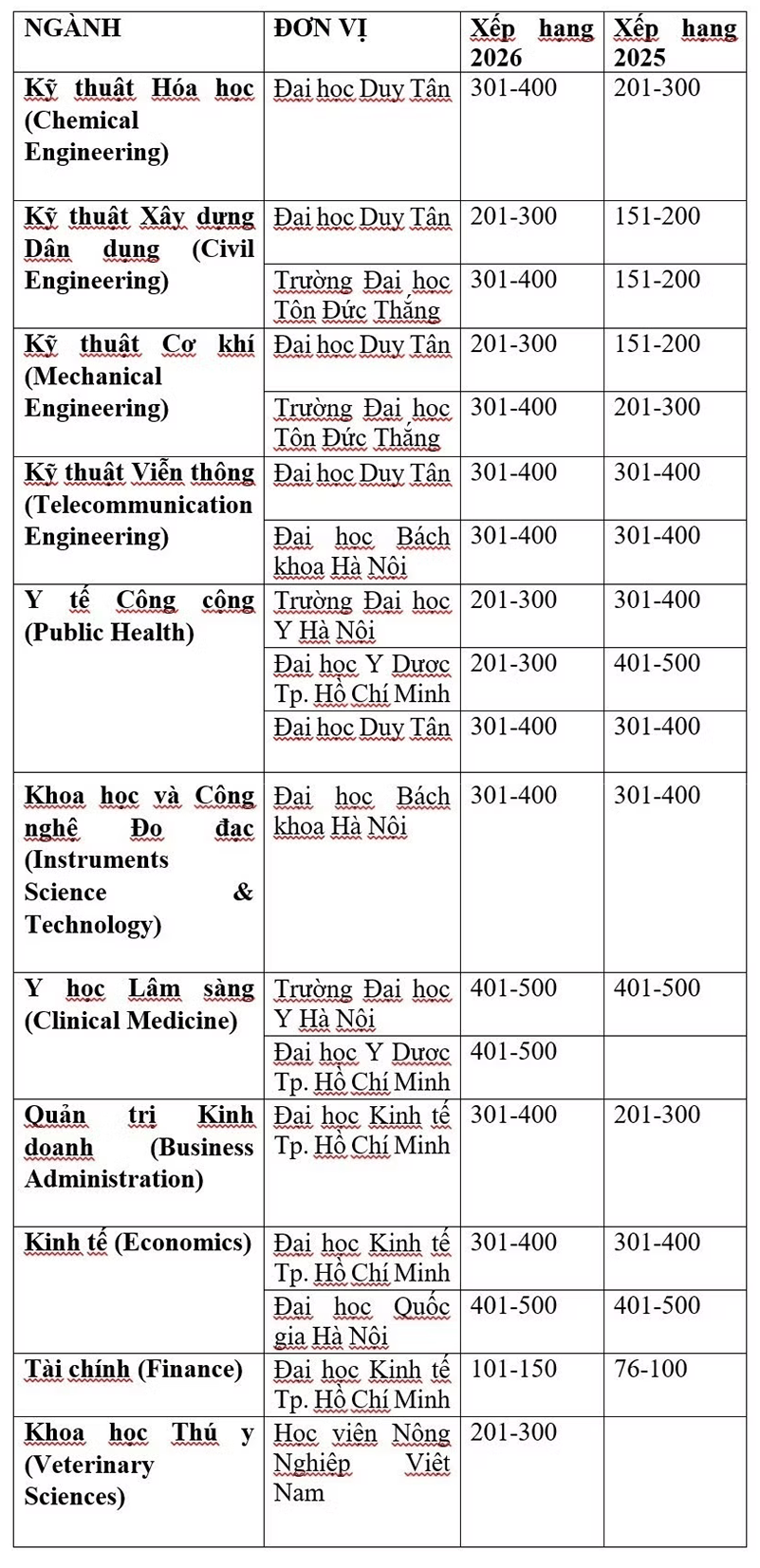
GRAS 2026 evaluated about two thousand education institutions in around a hundred countries and territories across 57 subjects in five broad fields: (1) Natural Sciences, (2) Engineering, (3) Life Sciences, (4) Medical Sciences, and (5) Social Sciences. Vietnam has eight higher-education institutions ranked across 18 entries in 11 subjects.
Hanoi Medical University continues to be ranked in two subjects:
- Clinical Medicine, and
- Public Health.
Its ranking in Public Health improved from 301- 400 globally in 2025 to 201-300 globally in 2026, while its ranking in Clinical Medicine remained at 401-500 globally.
The highest-ranked subject in Vietnam is Finance at the University of Economics Ho Chi Minh City (UEH), which placed 101-150 globally. However, this represents a decline from its 2025 ranking of 76–100 globally. UEH also has two other ranked subjects: Business
Administration and Economics, both in the 301-400 range globally.
Duy Tan University (DTU) once again has the largest number of ranked subjects, at five:
- Civil Engineering (201-300 globally),
- Mechanical Engineering (201-300 globally),
- Chemical Engineering (301- 400 globally),
- Telecommunication Engineering (301- 400 globally), and
- Public Health (301- 400 globally).
DTU maintained its 2025 rankings in two subjects and saw its rankings decline in three subjects.
VNU Ho Chi Minh City dropped out of the GRAS 2026 rankings, while VNU Hanoi had Economics ranked 401-500 globally, unchanged from 2025.
The Vietnam National University of Agriculture had Veterinary Sciences ranked 201-300 globally. This subject did not appear in the rankings in 2024 and 2025 after previously placing 20-300 in 2023.
The ShanghaiRanking’s Global Ranking of Academic Subjects is considered one of the most rigorous rankings currently available because of its stringent requirements on research quality. Under the GRAS criteria, a subject is considered for ranking only after meeting a minimum publication threshold between 25 and 300 research papers depending on the field.
Each broad field has specific requirements on publication numbers, with entry thresholds particularly high (many papers) or lower (generally ranging from 25 to 100 papers depending on subject):
- Natural Sciences: Physics requires 300 papers, while Chemistry requires 200–300 papers. Many other subjects, such as Mathematics, Geography, and Ecology, require at least 100 papers.
- Engineering: Materials Science & Engineering, Energy Science & Engineering, and Environmental Science & Engineering require 200 papers, while subjects like Electrical & Electronic Engineering have thresholds ranging from 100 to 150 papers.
- Life Sciences and Medical Sciences: Biology requires 200–300 papers, while Clinical Medicine requires as many as 300 papers. Even the Social Sciences, which generally have lower thresholds, still require between 25 and 100 papers, depending on subject.
GRAS currently uses five groups of indicators to evaluate universities by subject:
- World-Class Faculty: evaluates the number of international academic award laureates (Laureate), highly cited researchers (HCR), chief editors of international academic journals (Editor), and leadership of international academic organizations (Leadership).
- World-Class Output: evaluates papers in the world’s top journals (TJ) and international academic awards (Awards).
- High-Quality Research: evaluates the number of papers published in Q1 journals according to the international journal classification.
- High-Quality Research: evaluates the number of papers published in Q1 journals according to the international journal classification.
- Research Impact: evaluates the category-normalized citation impact (CNCI), which measures not only the volume of research output but also its academic influence, as reflected by how frequently it is cited by the global research community compared with the worldwide average.
- International Collaboration: evaluates the proportion of research conducted through international collaboration, highlighting GRAS’s emphasis on internationally connected research rather than research conducted solely within an institution or country.
With its high publication thresholds and clear differentiation among fields, GRAS considers only institutions with outstanding research capabilities. This results in high selectivity and is why the international academic community regards the ranking as a rigorous measure of the research performance of universities worldwide.
(Media Center)
Other News