Research

The DTU Nuclear Research department was founded in December 2015 and has published thirteen international research papers, with seven in ISI-indexed journals and leading journals, such as the well-read Physical Reviews.

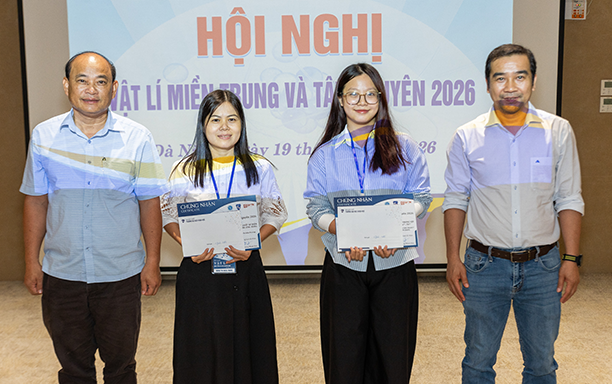
DTU nuclear researchers, from the left, Le Tan Phuc , Pham Thi Thuy Giang, collaborator, Dr. Tran Hoai Nam, team leader, and Associate Professor Nguyen Quang Hung
The three members of the team are Associate Professor Nguyen Quang Hung, with a Ph.D. from RIKEN, the Institute of Physical and Chemical Research in Japan, Dr. Tran Hoai Nam, with a Ph.D. and postgraduate studies from the Tokyo University of Technology, Nagoya University and Chalmers University in Sweden, and Le Tan Phuc. These and other researchers from Vietnam and abroad have now joined the DTU team and started collaborating.
Dr. Nam said: “Research in nuclear physics is most challenging worldwide because it requires a huge investment in nuclear reactors and accelerators, supercomputer systems and so on, and close contact with other scientists worldwide. In Vietnam, Nuclear Physics research is conducted at several large universities and institutes, such as the University of Natural Sciences at the National University in Hanoi, the Physics Institute of the Vietnam Academy of Science and Technology, the Vietnam Atomic Institute and the University of Natural Sciences at the National University in HCMC. However, Nuclear Physics research has not been a major priority at private universities. DTU is an exception, and, although it is private, DTU is determined to establish a nuclear research team and provide them with the most advanced facilities, in order to expand their work in the near future.”
In 2016, the team presented its papers at the International Conference of Nuclear Engineering and the International Conference of Nuclear Physics in Japan. The paper entitled “A Simultaneous Microscopic Description of Nuclear Level Densities and Radiative Strength Functions” has just been published in the influential Physical Review Letters, the world’s premier Physics journal of American Physical Society.
In this paper, the team, for the first time, introduced a micro theoretical model and a way of describing both the level density and radiative gamma-ray strength functions of nuclear atoms, with two parameters using a phaenomenologic or semi-micro model.
Another paper entitled “The Improved Treatment of the Blocking Effect at Finite Temperatures” by Associate Professor Hung and his co-workers provided a new way of describing the blocking effect of single protons or neutrons in an odd atomic nucleus at highly-stimulated temperatures.
A third paper by the team, entitled “The Effective Restoration of Dipole Sum Rules within the Renormalized Random-Phase Approximation”, provided a significant improvement in addressing the issue of Pauli Breaking in Random-Phase Approximation (RPA).
(Media Center)
Other News