Research
DTU Inaugurates Center for Research & Application of Ethnomedicinal Plants in the Central and Highlands Regions of Vietnam
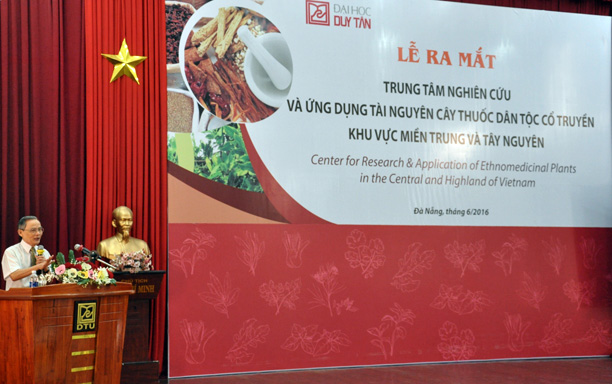
On June 24th, DTU inaugurated the Center for Research & Application of Ethnomedicinal Plants in the Central and Highlands regions of Vietnam (CRAEPCHV).

The center belongs to the DTU Institute for Research and Training in Medicine, Biology and Pharmacy and has an office and a small medicinal plant garden at the DTU campus in the Hoa Khanh Nam ward, in the Lien Chieu district of Danang, with laboratories and the latest equipment.
The main task of the center is to conduct surveys, research, conservation and cultivation of special medicinal herbs in Central Vietnam and the Central Highlands. The center will then gradually start creating new medicines, partner with local pharmaceutical companies and use them in hospitals and community clinics around Danang and Quang Nam province.
By integrating theory, research and practice, the center will offer students in health sciences with the specialized knowledge and professional skills, which they can then use to improve health services in Danang.


Distinguished Teacher Le Cong Co expressed his commitment to restoring the importance of Vietnamese traditional remedies in treating disease in Vietnam. Many years ago, his father conducted research in this field. Now the Vietnamese are using traditional Chinese and Western medicines and forgetting the older options. Recently, representatives of DTU and a Taiwanese university visited a museum of precious herbs. The university now organizes visits to the museum for students to conduct research, and then select and cultivate the herbs by planting them in the DTU herb garden.
Mr. Co tasked the center with collecting the prescriptions of Vietnamese traditional medicines and to work with expert herbalists to create and preserve them.
“Everything must be preserved, passed down and researched, to combine both Eastern and Western cures,” he explained. “In the near future, modern drug production techniques can be applied to Vietnamese traditional medicine to create pure, inexpensive drugs with fewer side effects.”
(Media Center)
Le Thi Nhu Hoa, a DTU health sciences student, presents one of the first research projects of the center, entitled “Total flavonoid content extraction and evaluation of several of its biological activities from Stixis Ovata extract”.
The center belongs to the DTU Institute for Research and Training in Medicine, Biology and Pharmacy and has an office and a small medicinal plant garden at the DTU campus in the Hoa Khanh Nam ward, in the Lien Chieu district of Danang, with laboratories and the latest equipment.
The main task of the center is to conduct surveys, research, conservation and cultivation of special medicinal herbs in Central Vietnam and the Central Highlands. The center will then gradually start creating new medicines, partner with local pharmaceutical companies and use them in hospitals and community clinics around Danang and Quang Nam province.
By integrating theory, research and practice, the center will offer students in health sciences with the specialized knowledge and professional skills, which they can then use to improve health services in Danang.
Assistant Professor Nguyen Ngoc Minh, DTU Vice Provost
Dr. Minh said: “We regard this as our first academic research startup project at DTU. Our initial objective will be to care for special medicinal herbs that need to be conserved, such as False Calumba in the Tra My commune in Quang Nam province. The center will research the reproductive characteristics of valuable plants which are currently threatened with extinction. Our goal is to reintroduce these species back into their natural environment and produce medicines to help reduce poverty and hunger and improve the health of local communities in a practical way.”
Hero of Labor, Le Cong Co speaks
Distinguished Teacher Le Cong Co expressed his commitment to restoring the importance of Vietnamese traditional remedies in treating disease in Vietnam. Many years ago, his father conducted research in this field. Now the Vietnamese are using traditional Chinese and Western medicines and forgetting the older options. Recently, representatives of DTU and a Taiwanese university visited a museum of precious herbs. The university now organizes visits to the museum for students to conduct research, and then select and cultivate the herbs by planting them in the DTU herb garden.
Mr. Co tasked the center with collecting the prescriptions of Vietnamese traditional medicines and to work with expert herbalists to create and preserve them.
“Everything must be preserved, passed down and researched, to combine both Eastern and Western cures,” he explained. “In the near future, modern drug production techniques can be applied to Vietnamese traditional medicine to create pure, inexpensive drugs with fewer side effects.”
(Media Center)
Other News