Undergraduate
Danang Develops First Project and Communication Plan for Science, Technology, Innovation, and Digital Transformation
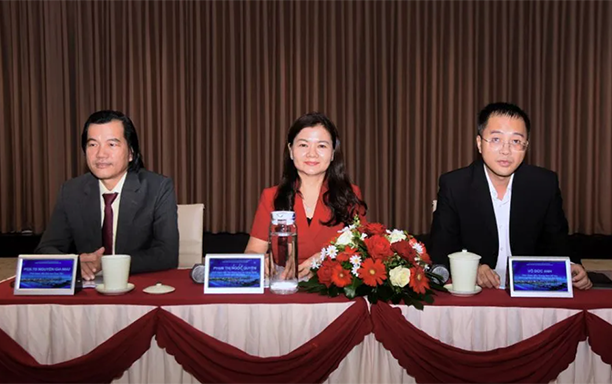
On October 10, 2026, the Danang Department of Science & Technology, through the Danang Innovation Startup Support Center (DISSC) partnered with Duy Tan University (DTU) to hold a workshop to gather feedback on a communication project for science, technology, innovation, and digital transformation for 2026-2030. This marks the first time the city has solicited broad public input on a communication project in these fields to meet new requirements for regular multi-platform communication. It was judged effective, following the conclusion of the 2022-2025 project and the issuance of new regulations.
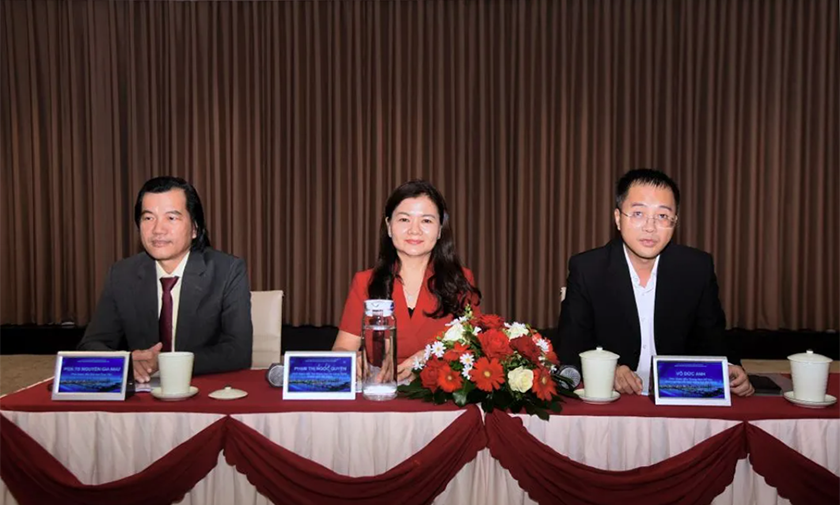
Chairpersons at the workshop, from left to right: DTU Vice Provost Assoc. Prof. Dr. Nguyen Gia Nhu;
Ms Pham Thi Ngoc Quyen, Deputy Director of the Danang Department of Science & Technology;
and Mr Vo Duc Anh, Deputy Director of the DISSC (under the Department of Science & Technology) - Photo: T. Ngoc
According to DTU Vice Provost Assoc. Prof. Dr. Nguyen Gia Nhu, communication on science, technology, innovation, and digital transformation in Danang and throughout Vietnam is facing new requirements from laws and policies, particularly resolution 57-NQ/TW of the Politburo, which emphasizes the breakthrough role of communication in reshaping public awareness and ways of thinking.
Specifically, decision 1169/QD-TTg by the Prime Minister on June 16, 2025, on the program “Strengthening communication on the implementation of resolution 57-NQ/TW through 2030” identifies communication as a key solution for raising awareness, renewing ways of thinking, and generating momentum for the development of science, technology, innovation, and digital transformation.
Ms. Pham Thi Ngoc Quyen, Deputy Director of the Danang Department of Science & Technology, emphasized that, as the fourth industrial revolution profoundly affects socioeconomic life, communication efforts must go beyond disseminating directives and policies to drive changes in awareness and behavior. They must spread research results, technological applications, and models of innovation and digital transformation. Communication should also connect resources and attract businesses, experts, and investors — to contribute to the development of the innovation ecosystem in the city.
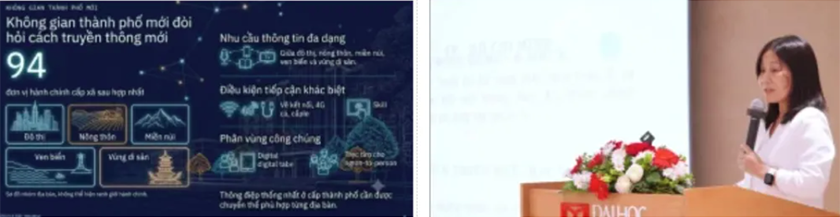
Dr. Hoang Thi Huong, Provost of the DTU School of Languages, Social Sciences,
& Humanities: “Public communication is an infrastructure of trust” - Photo: Xuan Thang
New context calls for new approaches and requirements for communication products
According to Assoc. Prof. Gia Nhu, the expansion of development space requires Danang to develop a new communication strategy for science, technology, innovation, and digital transformation appropriate to the specific characteristics of its 94 communes, wards, and special administrative zones. Communication efforts must extend beyond urban centers to reach every village, neighborhood, remote area, and ethnic minority. In practice, information-access disparities remain between urban areas, mountainous regions, and special administrative zones, while communication products tailored to disadvantaged groups remain limited. The new project therefore aims to ensure that “geography, age, language, and devices do not become barriers” to information and knowledge access.
Dr. Hoang Thi Huong, Provost of the DTU School of Languages, Social Sciences, & Humanities, and her colleague, MA Bui Kinh Khoi, emphasized the need to segment audiences and tailor content and communication methods to each location and target group: urban and rural areas, mountainous and coastal areas, and special administrative zones; businesses, startups, educational institutions, and international visitors.
Another important requirement is to move away from “communicating only for activities and promotion” toward “building infrastructure for understanding, trust, and action”. Accordingly, public engagement methods should evolve through four levels: communication, dialogue, participation, and co-creation.
Agreeing with this, Assoc. Prof. Dr. Le Dac Nhuong of the Faculty of IT at Haiphong University proposed a communication model in which government agencies provide leadership while communities participate in content creation, information dissemination, and feedback - to mobilize society for knowledge dissemination.
He also noted that communication effectiveness must be assessed on three factors: What does the public understand? What do they believe? How does their behavior change? Each target group needs practical information that meets its needs. For businesses, for example, technology communication should go beyond introducing solutions to clarify practical applications, investment costs, and where to get support in access and implementation.
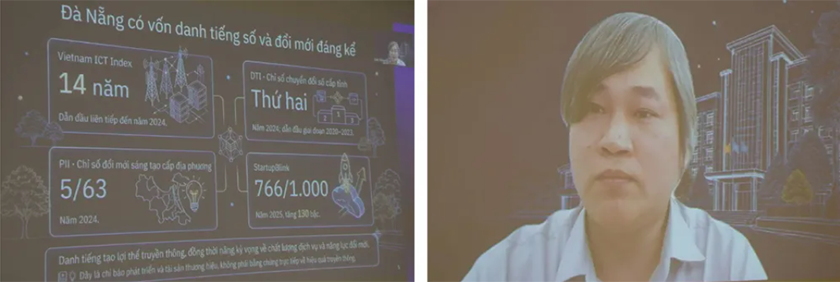
Assoc. Prof. Dr Le Dac Nhuong shared his insights remotely from Haiphong University - Photo: T. Ngoc
Communication as “infrastructure of trust”
Ms Ngoc Quyen of the Danang Department of Science & Technology affirmed that developing the communication project for science, technology, innovation, and digital transformation for 2026–2030 is essential, stemming from practical realities and the city’s direction of development.
According to her, communication remains poorly coordinated across different fields, agencies, and organizations. Content is fragmented and lacks a unified message framework. The application of digital technologies, AI, data analytics, and mechanisms for coordination and sharing of information remains limited. Communication targeting businesses, investors, and international partners does not yet fully meet needs.
The project is expected to lay the foundation for a long-term communication strategy with consistent messaging and coordination, while promoting the adoption of new technologies. Its goal is a professional, multi-platform communication model with clear priorities and tailored to different audience groups.
From a professional perspective, Dr. Huong of DTU emphasized: “Public communication is infrastructure of trust.” She noted that Danang could achieve breakthroughs by connecting science, data, and communities, but one must follow the principle of “pilot first, scale up later”. Each model should be implemented on a small scale, with baseline established in 2026. Its effectiveness and impact must then be verified before decisions are made about allocating funds for wider implementation.
Sharing this view, Dr. Le Van Chung, Director of the CVS at DTU, proposed an implementation process from pilot project, outcome measurement, and conditional expansion to recognition and institutionalization. To ensure objectivity, the city could commission independent consulting to conduct quantitative and qualitative surveys using representative samples, providing a basis for evaluating communication models.
Experts also proposed the principle of “one official source, multiple formats”, enabling press and media to explore diverse perspectives, stories, and individuals rather than simply reporting on events. More importantly, effectiveness assessment should move away from numbers of stories and articles to substantive changes in public awareness, trust, and behavior, supported by concrete data.
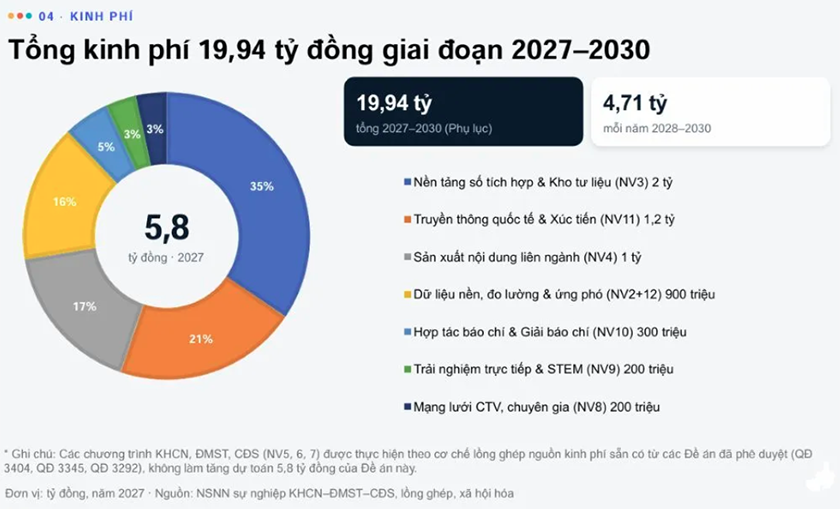
Estimated funding required for the project (excerpt from slides presented by project lead Assoc. Prof. Gia Nhu)
From bottlenecks to warnings for the new project
From the perspective of project lead, Assoc. Prof. Gia Nhu identified bottlenecks in science, technology, innovation, and digital transformation communication in Danang. Key issues include the lack of a central coordinating body and communication content that focuses too heavily on activities and achievements without adequately explaining benefits, risks, or specific actions people can take. Communication between scientific community and press also remains infrequent.
Sharing this assessment, Assoc. Prof. Dac Nhuong from Haiphong University observed that the city’s information systems, data, and communication channels remain fragmented and lack unified coordination. Although Danang has an extensive communication network, its actual effectiveness still depends on how well various stakeholders connect and coordinate.
In light of these challenges, Assoc. Prof. Gia Nhu emphasized that the project’s overarching goal is to build an ecosystem for science, technology, innovation, and digital transformation communication based on a unified architectural framework and data-driven operations. This must ensure that information is reliable, secure, and accessible while developing professional, multi-platform, multilingual communication tailored to different localities and audience groups.
Assoc. Prof. Dac Nhuong, Dr. Chung, and Dr. Huong also recommended changing the approach from focusing on events and achievements to following the entire innovation process: reporting even results, difficulties, failed experiments, and unmet targets. Transparency, including the disclosure of limitations, is considered essential to strengthening public trust.
Accordingly, the principle of “one official source, multiple formats” should be applied flexibly, allowing the press to explore diverse perspectives, individuals, and stories rather than simply reporting on events. Measures of communication effectiveness should move away from numbers of stories, articles, and views to substantive changes in public awareness, trust, and behavior, supported by concrete data.
In a presentation analyzing domestic and international experience in science, technology, innovation, and digital transformation communication, Dr. Huong and MA Kinh Khoi warned against eight risks: copying models and platforms merely for appearances, equating views with impact, chasing trends and events, conducting consultations without feedback, focusing exclusively on digital communication while neglecting disadvantaged groups, overusing AI without verifying information, relying on one familiar group of experts, and failing to manage data versions.
They stressed in particular that metrics such as views, the number of accounts reached, and the number of events reflect only the scale of communication efforts; they do not directly translate to levels of understanding, trust, or behavioral change. Inclusive communication combining in-person with digital, audio, and short videos should be tested, evaluated, and adjusted to practice rather than remaining goals.
Regarding effectiveness evaluation, Assoc. Prof. Dac Nhuong recommended integrating communication throughout policy development and implementation. He noted that development achievements and policy implementation results cannot automatically be taken as evidence of communication effectiveness; they must be distinguished from indicators that reflect direct impact on the public.
Taking the workshop’s feedback into account, Ms Ngoc Quyen of the Danang Department of Science & Technology affirmed that the lead agency would continue refining the project to make it practical, feasible, and focused; to clearly define the responsibilities of all parties and select communication methods suited to different target groups - to meet the city’s development needs for 2026-2030.
As social media and generative AI develop rapidly and are expanding the ability to produce and distribute content while increasing the risks of misinformation, online scams, and fake news, communication on science, technology, innovation, and digital transformation must increasingly focus on building trust, on strengthening people’s ability to verify information, and on helping them use technology safely.
According to the draft, the project on communication on science, technology, innovation, and digital transformation in Danang for 2026-2030 is necessary to unify strategic direction, a central coordinating body, and a consistent communication framework. It will also bring together and make effective use of resources from existing programs and projects to avoid overlap and fragmentation. The project will also clearly define tasks, coordination responsibilities, timelines, funding, and evaluation criteria to serve as a basis for implementation, inspection, and monitoring. These efforts are to position Danang as a regional hub for science, technology, innovation, and digital transformation and attract highly skilled professionals, investment, and domestic and international collaboration.
(Media Center)
Other News