“The Magic Hand”, a prosthetic finger for people with disabilities developed by a team from Duy Tan University (DTU), outstandingly won first prize at the Vietnam Global Startup Challenge 2025. The project was judged to have strong practical applicability, potential to grow into a sustainable startup, and the ability to spread profound humanitarian values - all to improve the quality of life for people with disabilities.
The Vietnam Global Startup Challenge 2025, organized by the Hanoi Youth Union, focuses on fostering an entrepreneurial spirit among Union members and young people, equipping them with knowledge and skills, giving young Vietnamese people access to the resources they need to turn startup ideas into reality, and developing an ecosystem supportive of Vietnamese startups.
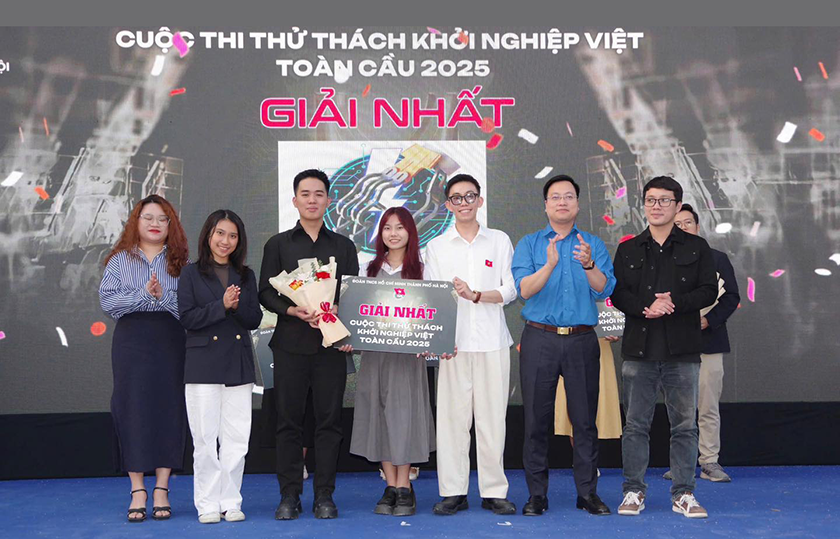
“The Magic Hand” won first prize at the Vietnam Global Startup Challenge 2025
More than a thousand contestants - young people, students, and young intellectuals of Vietnamese nationality working or studying in Vietnam or abroad - submitted creative products of high quality. The students came from many prestigious institutions across the country, such as the University of Economics Ho Chi Minh City, the University of Science of the Vietnam National University HCMC, DTU, Ton Duc Thang University, Saigon University, and Swinburne University of Technology. Their exuberant participation created a highly connected playground for studying and entrepreneurship.
The final round of the Vietnam Global Startup Challenge 2025 on December 23, 2025, honored the teams with the most outstanding startup projects:
- first prize: MagicHand,
- second prize: MedVietAI,
- third prize: WeeUP and GeneSkinAI.
The first-prize winners designed a prosthetic finger for people with disabilities. The team consists of five DTU students:
- Nguyen Ngoc Anh Quyen,
- Doan Le Anh Thu,
- Phan Trinh Quynh Mai,
- Nguyen Huynh Dang Khoa, and
- Tra Tran Minh Kha.
Anh Quyen explains how the idea behind the project “The Magic Hand” started from very practical concerns: “During our field research, we realized that the number of disabilities at hands and fingers in Vietnam is steadily increasing due to various causes, such as workplace accidents, chronic arthritis, complications from diabetes, bone cancer, and especially the lasting effects of war. Meanwhile, current support solutions do not effectively meet the needs of individual cases. This is why our team researched and developed a prosthetic finger that comes at affordable cost and is of high quality - to bring convenience, comfort, and greater confidence to the daily lives of people with disabilities.”
Video introducing the project “The Magic Hand”
To create a prosthetic finger that is stable in quality, safe, and affordable, the DTU students developed a production process based on two main technologies:
- 3D printing, and
- mechanical processing.
“The prosthetic finger in the project ‘The Magic Hand’ was designed in modular form,” Dang Khoa explains. “This allows each part to be detached and easily replaced. The product uses 304 stainless steel, nylon 12, silicone, and carbon fabric. It can withstand loads of up to 10 kg and perform natural bending and extending motions up to 90°. This gives Vietnamese people with disabilities in the fingers access to a high-quality, durable, and highly flexible prosthetic finger. When a component is damaged, the user only needs to replace that part instead of purchasing an entirely new device.”
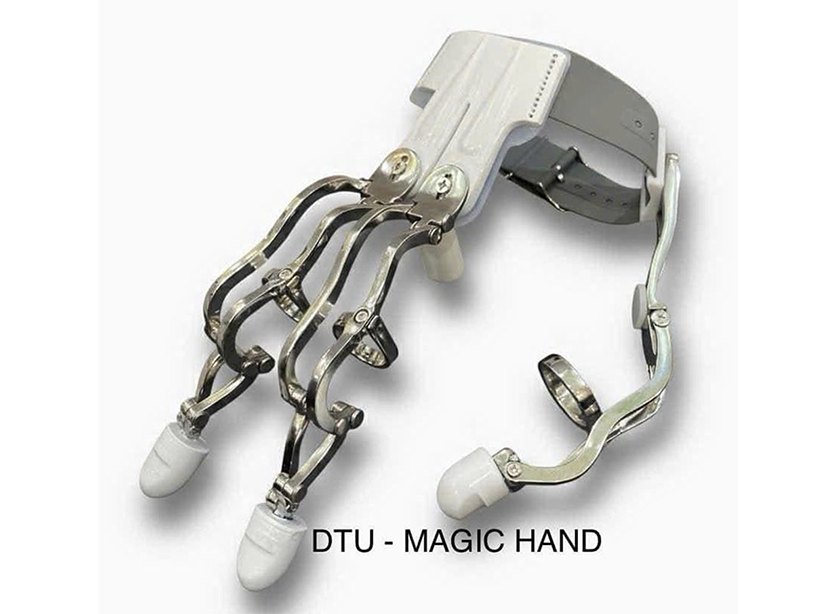
Project “The Magic Hand” - a prosthetic finger for people with disabilities
Another major advantage of the prosthetic finger designed in “The Magic Hand” is its customizability to all hand sizes, creating a sensation like that of a real hand. For people with disabilities, this goes beyond convenience. It restores a sense of independence by enabling them to work in jobs that require flexible gripping skills, such as garment manufacturing, mechanics, agriculture, and handicrafts. It also allows the user to hold objects, eat, drink, and perform daily tasks without assistance.
In addition to focusing on high-quality product design that meets the practical needs of the disabled, the DTU team also oriented the project towards sustainable startup criteria - a core focus of the Vietnam Global Startup Challenge 2025.
“Along with the technology side, we carefully balanced cost, production, and scalability, so that our product is both humanitarian and commercially viable,” Minh Kha explains. “This harmonious combination of practical solution, feasible business model, and a long-term development vision is what earned ‘The Magic Hand’ such high evaluations.”
With support in machinery, technology, and dedicated professional guidance from DTU staff and lecturers, the student team fully implemented all stages of a well-structured technology project: from a survey of real-world conditions and community needs, and model design and testing to finalizing prototypes, pilot production, and collecting user feedback.
“Each person with a finger disability has different finger sizes, different joints that are missing, and different grip strengths,” Anh Thu affirms. “So we had no standard measurement template. That’s why we spent a lot of time adjusting and refining the design, to recreate the feeling of natural finger movement by optimizing springs and rotary joints, and by selecting appropriate soft assistive materials. Our design was greatly supported by DTU’s mechanics practice labs and the STEM & Fabrication Laboratories or STEM & FAB LABs, with 3D printers, CNC machines, and force gauges. And the dedicated professional guidance from MSc Dang Ngoc Sy, Director of the Center for Mechanical Engineering and DTU lecturer, improved feasibility and sustainability.”
(Media Center)