On January 10, DTU held a seminar titled “Blockchain: From technological platform to applications in digital finance.”
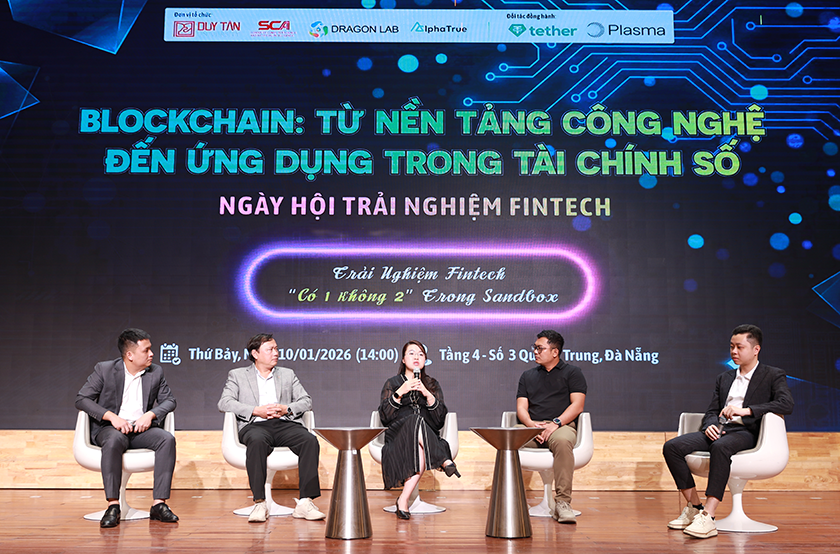
Experts share insights into the relationship between blockchain technology,
legal frameworks, and compliance requirements in real-world practice
The seminar was attended by financial and technology experts from AlphaTrue Joint Stock Company, Dragon Lab Joint Stock Company, the Tether Group, and the Plasma Group, as well as nearly 2,000 students from programs in Information Technology, Economics, and Finance & Banking.
Since the law on the digital technology industry officially took effect on January 1, 2026, P2P digital asset transactions in Vietnam may come with significant legal risks. Participants could unintentionally become involved in money laundering, tax evasion, or the financing of illegal activities, potentially leading to account freezes, tax reassessments, or even criminal liability - despite having no malicious intent.
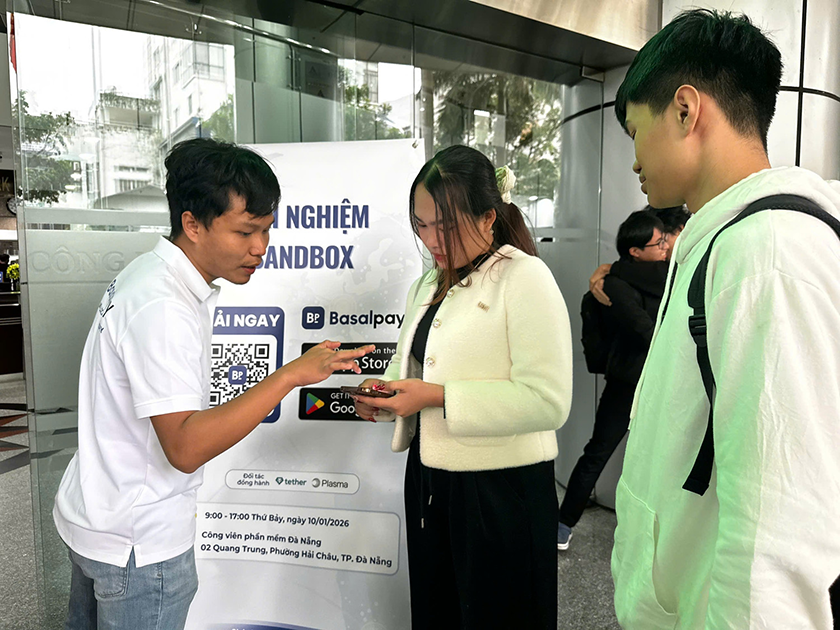
Students could get hands-on experience with digital assets at the seminar
As Vietnam gradually completes its legal framework for piloting digital asset activities, the seminar organized by DTU aimed to connect academic research with the practical implementation of regulatory sandbox mechanisms in the country.
According to Associate Professor Dr. Nguyen Gia Nhu, Provost of the DTU School of Computer Science and Artificial Intelligence, blockchain is no longer an experimental technology. Still, it is steadily becoming a new value infrastructure layer of the digital economy. He emphasized that integrating blockchain, distributed data, and digital finance into university curricula plays a crucial role in preparing high-quality human resources, while also creating a bridge between research, education, and real-world deployment in enterprises.
At the seminar, speakers focused on analyzing key issues, including legal risks, fraud, and money laundering in digital asset transactions; sandbox mechanisms; KYC, AML, and KYT processes; non-custodial digital asset models; and blockchain applications in smart finance. Notably, Danang’s sandbox model was introduced as a controlled environment for testing digital finance initiatives under the supervision of regulatory authorities.
Danang has taken the lead in implementing a lawful sandbox mechanism, assigning the Department of Science and Technology as the focal point for receiving, evaluating, and licensing pilot projects in fintech, blockchain, and digital assets. This mechanism is expected to promote innovation while ensuring the safety of the financial system, contributing to Danang’s vision of becoming a national hub for digital finance and innovation.
In addition to the academic content, the seminar also offered hands-on experience with digital assets within the sandbox framework. These experimental activities were designed to illustrate how models for converting digital assets into fiat currency can be permitted by regulators on a controlled trial basis.
Through these experiential activities, students could directly observe lawful digital asset conversion processes and track how transaction data is recorded for supervisory purposes. As a result, the program helped learners better understand the interplay between technology, law, and compliance. These factors are becoming the foundation for bringing digital assets into a legitimate development trajectory.
The seminar was not only an academic event but also a practical educational activity, enabling students to experience legal digital finance applications and enhancing their awareness of financial safety and legal compliance in the digital asset sector.
(Media Center)