Achievements

MD Huynh Le Thai Bao, a lecturer at the DTU Faculty of Medicine, has won first prize at the Young Investigator Award at the 23rd ASEAN Federation of Endocrine Societies Congress (AFES 2025).
The conference is one of the most prestigious scientific events in the fields of endocrinology, diabetes, and metabolic disorders in the region. It was organized by the Vietnam Association of Diabetes & Endocrinology (VADE) in collaboration with the ASEAN Federation of Endocrine Societies (AFES) from November 14th to 16th in Danang.
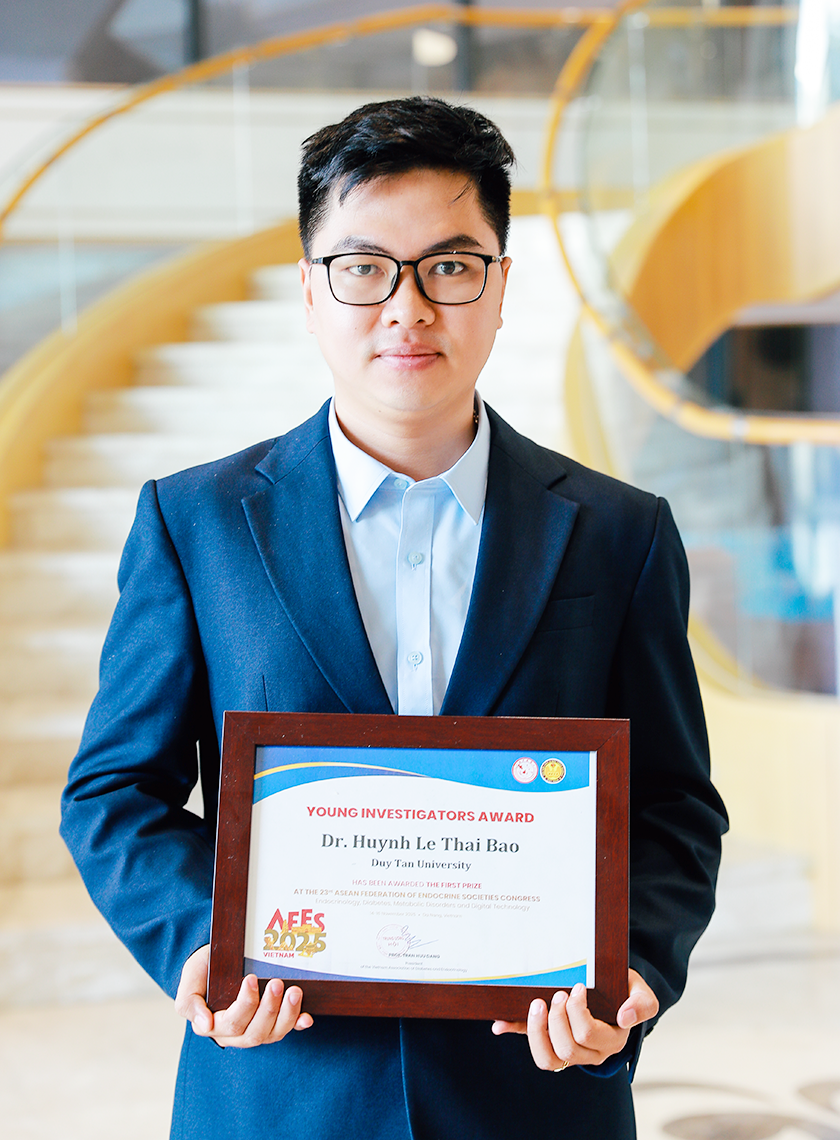
MD Huynh Le Thai Bao wins First prize at the Young Investigator Awards
Focusing on harnessing the potential of:
• Artificial Intelligence (AI),
• Big Data,
• Internet of Things (IoT), and
• Cloud Computing
in developing precision medicine solutions that support early diagnosis, risk prediction, and optimization of diagnostic and treatment processes, particularly for chronic diseases with severe complications such as diabetic foot, AFES 2025 attracted over 500 international delegates and more than 1,200 domestic participants, including professors, associate professors, physicians, scientists, and leading experts from around the world. The organizers received a total of 270 submissions from domestic researchers and nearly 100 from international researchers.
At the conference, MD Thai Bao presented his study “Evaluation of diabetic foot by wounds, ischemia, and foot infections (Wifi) classification system”.
MD Huynh Le Thai Bao said: “Our research focuses on key risk factors related to risk stratification and limb amputation outcomes in patients with diabetes, particularly new quantitative tools such as Toe Pressure (TP), Toe-Brachial Index (TBI), and several other measures included in the WIfI (Wound - Ischemia - Foot Infection) scoring system. Based on this, we have preliminarily proposed some risk calculation models for limb amputation specifically for Vietnamese patients. Since this is the early stage of the study, the sample size is still limited and there are several constraints. We aim to address these issues to achieve more robust and reliable results in the future,” said PhD,
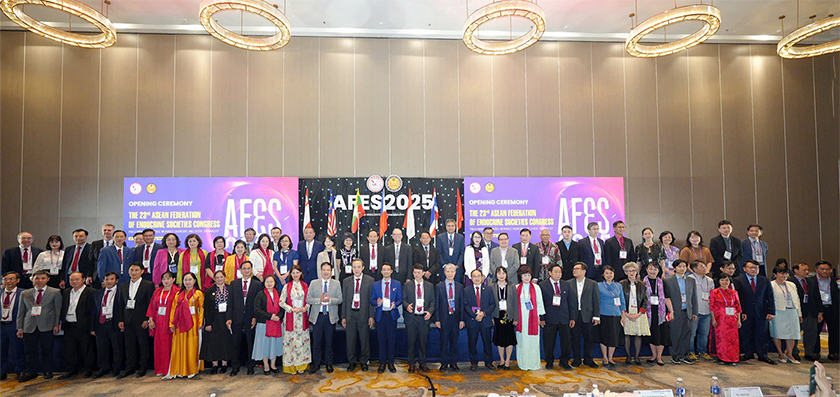
Researchers at the AFES 2025
It is known that limb amputation and blindness are the two most severe complications in patients with diabetes. Diabetic foot is a serious condition with multiple complex mechanisms (including wounds, ischemia, infection, and musculoskeletal neuropathy) that can lead to amputation. Every 20 seconds, somewhere in the world, someone undergoes a limb amputation due to diabetes-related complications.
In Vietnam, assessing diabetic foot using tools such as the Wagner classification, SINBAD, and basic clinical examination, while important and necessary, still has certain limitations. Therefore, the research project “Evaluation of Diabetic Foot by Wounds, Ischemia, and Foot Infections (WIfI) Classification System” by MD Huynh Le Thai Bao and colleagues was highly praised for its significance and was awarded First prize in the Young Investigator Award at the AFES 2025.
The Young Investigator Award is given to submissions by scientists under 35. The evaluation criteria include:
- Innovativeness,
- Level of Participation,
- Scientific and Practical significance, and
- Presentation skills.
“Applying the Wifi classification system enables a comprehensive assessment of diabetic foot across multiple mechanisms, helps predict the risk of amputation, and guides appropriate treatment strategies,” MD Thai Bao explains. “This contributes to standardizing clinical assessment and care procedures, improves treatment, and reduces patients’ disease burden. For my research, I’m deeply grateful for the support of the lecturers at the Hue University of Medicine & Pharmacy; the encouragement and favorable conditions provided by the DTU Board of Provosts and the lecturers at the DTU Faculty of Medicine; and the organizers of the AFES congress for giving me the opportunity to report on this meaningful topic.”
(Media Center)
Other News