Achievements
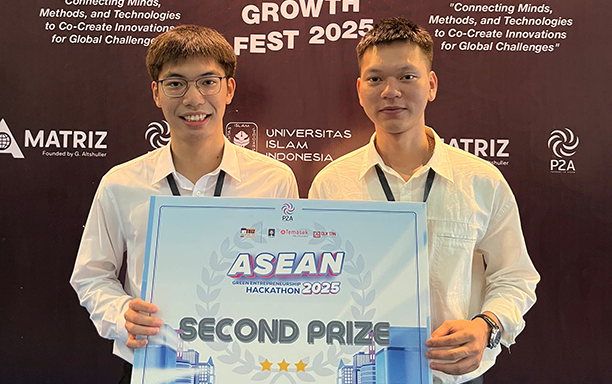
“The Magic Hand”, a design for a prosthetic finger for people with disabilities by four DTU students, has outstandingly won second prize at the finals of the ASEAN Entrepreneurship Hackathon 2025 in Indonesia.
Outstanding for its technological innovation and remarkable for its deep humanistic spirit, “The Magic Hand” is a design for a prosthetic finger for people with disabilities developed by four DTU students:
- Nguyen Ngoc Anh Quyen,
- Dao Duc Anh Hoang,
- Nguyen Huynh Dang Khoa, and
- Doan Le Anh Thu.
The project has outstandingly won second prize at the finals of the ASEAN Entrepreneurship Hackathon 2025 on November 11, 2025, at Universitas Islam Indonesia (UII).
“During our research on people with disabilities in Vietnam, we realized that the number of disabilities at hands and fingers is steadily increasing due to various causes, such as workplace accidents, chronic arthritis, complications from diabetes, bone cancer, and especially the lasting effects of war,” Nguyen Ngoc Anh Quyen reflects on the humanitarian starting point of the team’s project “The Magic Hand”. “Notably, the types of disabilities at the fingers among Vietnamese people vary significantly from case to case, making it very hard to design assistive devices. Based on this, we determined to design a prosthetic finger that is low-cost yet high-quality and adaptable, with the hope of making people with disabilities more comfortable and confident in their daily lives.”
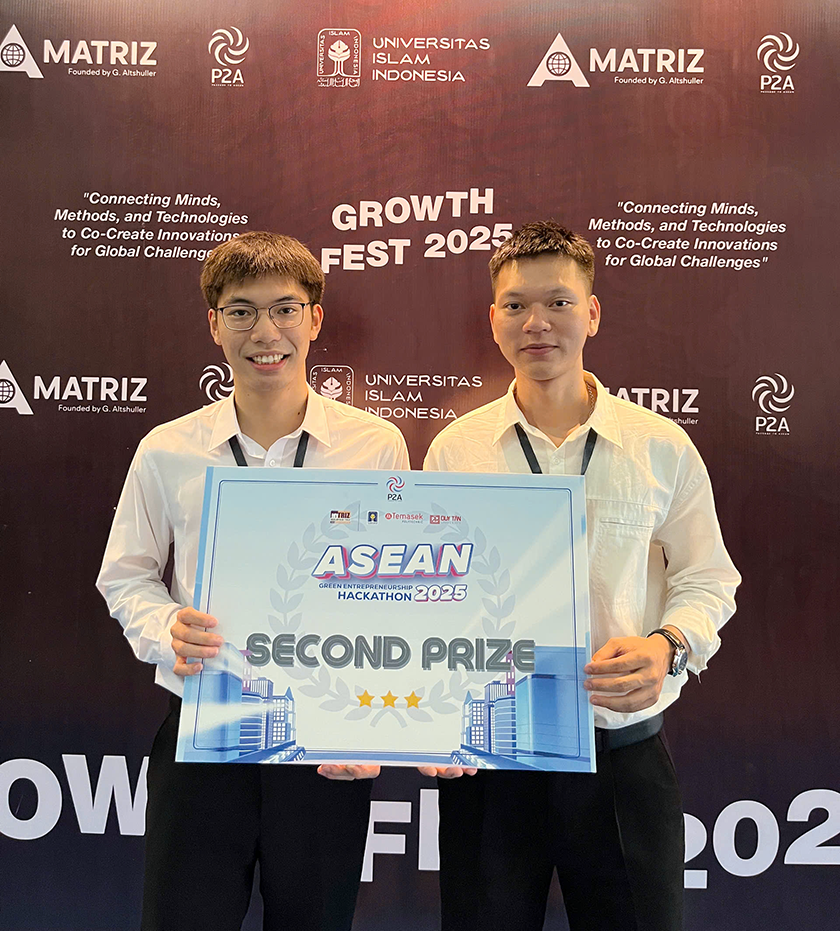
“The Magic Hand” won second prize at the finals of the ASEAN Entrepreneurship Hackathon 2025
Once the team had determined how to implement the idea, they immediately began designing the product. They scanned and collected biometric data from various disabled people to create size standards appropriate to Vietnamese users.
“From this data, each component of the prosthetic finger was redesigned using 3D simulation software,” Nguyen Huynh Dang Khoa explains. “This allowed us to test durability, load capacity, and flexibility before moving on to production. After passing all technical tests, the product entered the clinical trial stage, where people with disabilities used it and provided feedback on comfort, aesthetics, grip ability, and overall support in daily activities.”
Video clip introducing the project “The Magic Hand”
To create a prosthetic finger that is stable in quality, safe, and affordable, the DTU students developed a production process based on two main technologies:
- 3D printing, and
- mechanical processing.
“The prosthetic finger in the project ‘The Magic Hand’ was designed in modular form,” Dao Duc Anh Hoang adds. “This means that each part can be detached and easily replaced. This is particularly suitable for people with disabilities and a limited income, as they only need to replace the damaged component rather than buy an entirely new device.
“The product uses 304 stainless steel, nylon 12, silicone, and carbon fabric. It can withstand loads of up to 10 kg and perform natural bending and extending motions up to 90°. These are specifications that, until now, Vietnamese people with disabilities could only get from expensive imported products.”
Another major advantage of the prosthetic finger designed in “The Magic Hand” is its customizability to all hand sizes, creating a sensation like that of a real hand. For people with disabilities, this goes beyond convenience. It restores a sense of independence by enabling them to work in jobs that require flexible gripping skills, such as garment manufacturing, mechanics, agriculture, and handicrafts. It also allows the user to hold objects, eat, drink, and perform daily tasks without assistance.
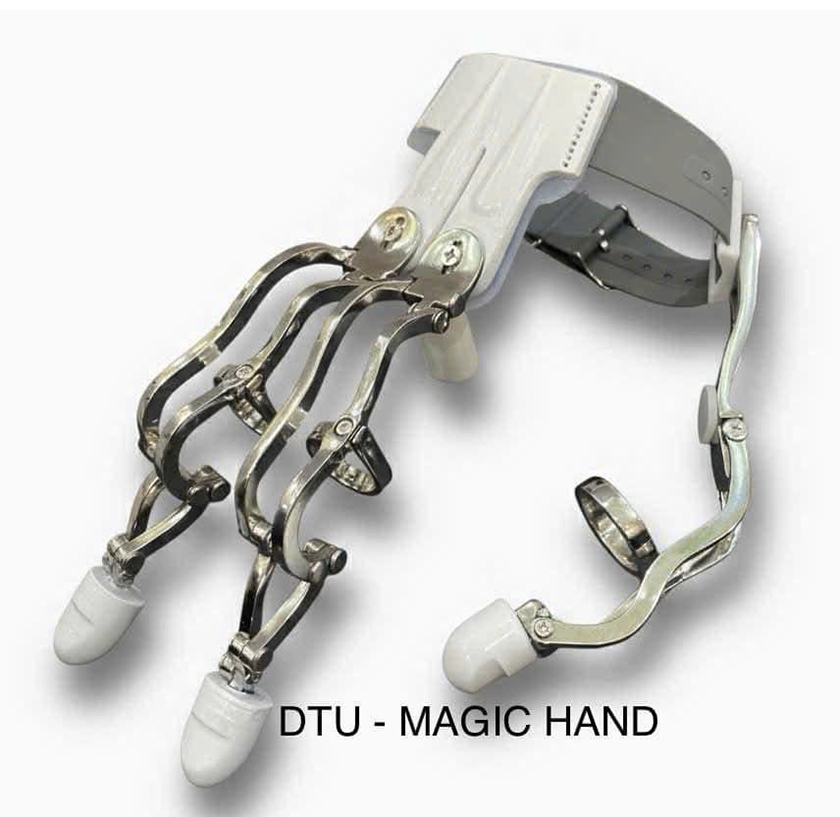
“The Magic Hand”, a design for a prosthetic finger for people with disabilities by DTU students
With support in machinery, technology, and expertise from DTU staff and lecturers, the student team completed all stages of a fully developed technology project, from researching current supply and community needs, designing models, and trials to refining a prototype, producing a test batch, and gathering user feedback.
“Each person with a finger disability has different finger sizes, different joints that are missing, and different grip strengths,” Doan Le Anh Thu explains. “So we had no universal standard for accurate measurement. We spent a lot of time adjusting the blueprints, determined to recreate the feeling of a finger using springs, rotary joints, and soft materials. Our design was greatly supported by DTU’s mechanics practice labs and the STEM & Fabrication Laboratories or STEM & FAB LABs, with 3D printers, CNC machines, and force gauges. And the close guidance of our lecturers allowed us to complete the product just as we had hoped.”
The prosthetic finger design from the project “The Magic Hand” advanced through:
- national round: most outstanding project,
- semifinals: ten teams from nine universities in the ASEAN region,
- finals: the three most outstanding teams in the ASEAN region,
and won second prize at the ASEAN Entrepreneurship Hackathon 2025.
More than a practical tech project developed by DTU students in the laboratory, “The Magic Hand” is also a testament to compassion and to the belief that technology only has true value when it serves people.
(Media Center)
Other News