Undergraduate
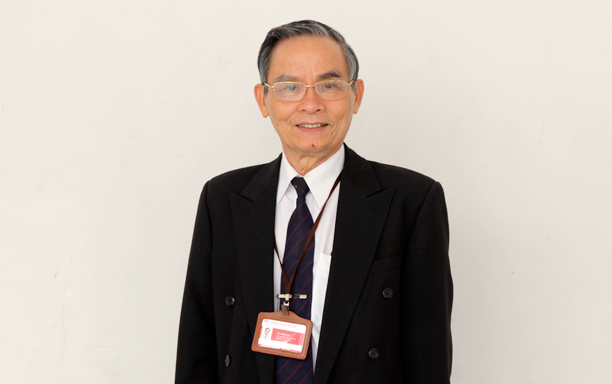
“Through our collaborations with the world’s finest universities, we have learned much. Our partners have taught us in how to effectively stand on the shoulders of giants, instead of going nowhere at all.” This is what Distinguished Teacher Le Cong Co, Duy Tan University Provost, wants us to know.
Distinguished Teacher Le Cong has been at the helm at DTU for almost 22 years and has steered the school into the group of the top six private universities in Vietnam. Dan Tri reporters interviewed Distinguished Teacher Le Cong on the current development of education at DTU and in Vietnam in general.

Distinguished Teacher Le Cong Co
Internationalizing the Work Environment
As far as I know, you were instrumental in the improvement of education based on the transfer of technology and academic programs from leading international universities into the Vietnamese higher education system. Can you explain why you planned to do this?
One of DTU’s strategic guiding principles that we always come back to is to attain the highest quality of education through international collaboration. In 2008, with this in mind, the university actively initiated the first partnership to successfully create new, international standard Bachelor degree courses in Information Technology, Information Systems and Network Engineering, in conjunction with Carnegie Mellon University, one of the four leading universities in IT in the United States.
This partnership has been a stepping stone for DTU to continue signing agreements to transfer other programs, in Business Administration, Accounting, Banking, Finance and Hospitality from Pennsylvania State University, PSU, one of the three leading universities in Management and Hospitality worldwide and one of the five largest public universities in the US, and in conjunction with California State University, CSU Fullerton and Cal Poly, one of the leading universities in Construction and Architecture on the US West Coast.
As well as importing these advanced programs, DTU then established another precedent by arranging to transfer students abroad to gain international degrees. At the end of 2014, DTU paired up with Upper Iowa University in the US, to allow Vietnamese to study here at home but earn an international degree at the same time, an important new step in the improvement of education at DTU.
Through these collaborations, we annually send 270 of our lecturers abroad, to the US, Asia and Europe, to improve their expertise and refine their teaching methods, to bring them up to the standards set by the partner universities. Our foreign partners also send lecturers regularly to DTU to teach specialized courses here and jointly organize special seminars.
Through these experiences, we have learned how to work and advance with the help of our partners. Their skilled visiting lecturers have improved the professionalism of our lecturers, and, as a result, the academic environment here is gradually becoming more internationalized and graduates of these courses normally find well-paid jobs. Finally, our partnerships have boosted the reputation of DTU, and, subsequently, the university has been accredited with numerous international awards.
The Dangers of Not Focusing Education on the Humanities
DTU is currently the leading private university nationwide with its model of "An education and research system based on the humanities”. Can you give us the reasons please?
In any nation, an education system that is not founded on the humanities can be detrimental. By teaching the humanities, we become stronger and Vietnam should recognize that. Humanities does not just encompass person-to-person relationships, but also our relationships with family, schools, our communities and the environment. So far, education has not yet focused on the humanities, which is risky.
A university should be expected to teach wide range of innovative topics and creative skills. Currently the Vietnamese system crams students with knowledge, but they still lack autonomy in their studies and do not learn vital basic life skills. Their education is therefore divorced from every-day reality. We must all concentrate on creating a system which inherits and integrates the study of the rich humanitarian traditions of our country.
Reportedly, the university has recently published 130 international research papers, of which 122 appear in ISI indexed journals. How did you encourage your lecturers to begin focusing on research?
First of all, the university founded the Institute for Research and Development and the Institute for Economic and Social Research, to attract PhDs from well-known institutions worldwide. Then we established several new policies, including policies on salaries, the creation a professional, friendly, efficient and democratic work environment, the encouragement of group research rather than individual, and the satisfaction of requests for more labs and more foreign training opportunities to enhance lecturer research capabilities.
What do you expect of your researchers?
We want our researchers to create an academic research environment linking lecturers and students. Meanwhile, we require our experts to publish international papers which bring us prestige and strengthen our partnerships with other universities in the region and around the world.
We now have several researchers with 10 or more ISI high-impact publications in well-known international journals. The university expects these individuals to become leading authorities in their specialties, not only at DTU and in Central Vietnam, but nationwide.
Vietnamese higher education should focus on applied research. As a long-term, highly experienced educator, how do you think that higher education should now be oriented?
As said before, DTU is a university offering education linked with applied research based on the humanities. Higher education should therefore focus on applied research and training in the soft skills, in order to create an entrepreneurial environment for lecturers and students.
When I say entrepreneurial, I mean it in the sense of developed universities in the West. There must be an official research hub, located at the university, with start-up products and projects that can attract national and international investment. There should be lines of related start-up products, depending on the strengths of the university, instead of the traditional incubators that other universities in Vietnam have developed, which have had little commercial impact.
MOET recently offered a choice eight core mission options for future academic development: A review of the network of educational institutions nationwide; the training and development of lecturers and management staff to improve educational standards; splitting junior high schools into branches; focusing leadership on university autonomy with self-evaluation; improving English language education and making it the second language; increasing IT educational applications; promoting the internationalization of education; and recommending a list of basic disciplines that must be taught first.
Which ones do you think should get priority and why?
Above all, we should comprehensively unify the university and college management system, except in government of national defense and security. We should not allow our education networks to be fragmented by numerous ministries, branches and provinces, which reduces the quality of our universities and colleges.
At the same time, we should establish English as our second language, apply Information Technology to education and internationalize education for regional and international integration to modernize our country.
With your experience of leading a university for 22 years, what do you think a Provost should do to develop a university, its quality, and prestige?
The first and biggest task of a Provost is to define a mission, to clearly state a vision, to create objectives and to set concrete goals. After that, a Provost must hire capable people to create a relaxed and free study environment, to achieve the objectives I have already mentioned.
The Provost is the essential link between the School Board, combining all the elements they are both responsible for. Without the strong and effective leadership of the Provost, no university management system can function effectively.
(Media Center)
Other News