Collaboration
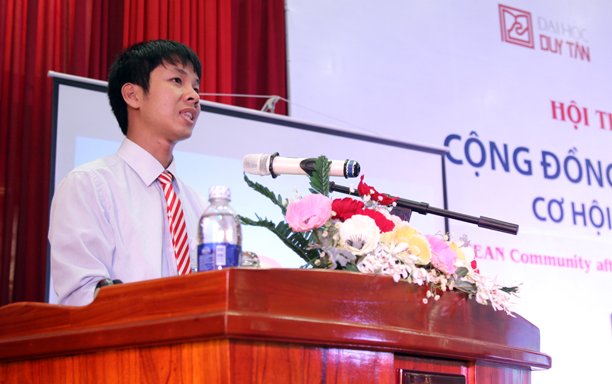
On May 15th, Duy Tan University partnered with the Institute for Southeast Asian Studies at the Vietnam Academy of Social Sciences and the Association of Universities and Colleges of ASEAN (P2A) to organize an international seminar entitled: “The ASEAN Community after 2015, Opportunities and Challenges”. Over 110 research papers from 26 Vietnamese and foreign universities and institutes were submitted.
The ASEAN market has huge potential, with over 612 million inhabitants. With the ASEAN Economic Community (AEC) about to become reality at the end of 2015, ASEAN will become the third largest market in the world, with the third largest population, 8% of the world, after China and India.
The significant growth of the middle class will lead to high purchasing power. Freeing trade in commodities will ensure supply of raw and finished materials inside the ASEAN region, due to the abolishment of tariffs. Market conditions will encourage manufacturers, producers and distributors of high-quality commodities to compete with those from other countries. However, consumers will also have the option of choosing between the cheapest to most expensive items available.

A scholarly debate at the workshop
Dr Werner R. Murhadi of the University of Surabaya in Indonesia affirmed that ASEAN integration will bring about a positive increase in economic activity in the region. The AEC will ensure five things: free movement of goods, a free flow of services, a free flow of investment, a free flow of capital and free movement of skilled workers.
The AEC will give ASEAN members the opportunity to expand their economies, to reduce the gap between rich and poor and to decrease socioeconomic disparity, to increase attractiveness to investors and tourists, to increase commercial transaction fees, and to improve trade and business organizations. In addition, the existence of the AEC will bring the benefit of having access to the internal ASEAN market, improve transparency, and accelerate national adjustment to common standard regulations.
Associate Professor Hoang Khac Nam, Dean of International Studies at the University of Social Sciences and Humanities at VNU in Hanoi, voiced the opinion that developing economic links inside ASEAN will help create the preconditions and a favorable environment to overcome disagreements over security and politics, historical obstacles, economic difficulties, and socioeconomic issues. Meanwhile, promoting socioeconomic collaboration creates conditions of mutual political understanding. Cooperation in these two areas will create new relations. Moreover, they will lead to favorable conditions for enforcement and to fewer clashes on security and politics.
Dr Nguyen Huy Hoang of the Institute of Southeast Asian Studies, put the issue this way: When ASEAN is near its milestone of establishing an economic community at the end of 2015 as planned, there will be much debate about the model and the shape of the post-2015 AEC. ASEAN will have to strengthen the economic scorecard system and develop it into an objective tool for the assessment of member integration and regional economic health. This economic scorecard can also provide information related to regional priorities and help achieve efficient, comprehensive, and sustainable growth. In addition, the scores can motivate improvements by highlighting what does and what does not work for community and region.
According to the organizers of the workshop, clarifying the opportunities and challenges facing the ASEAN after 2015 has great importance for asserting the vision of the community after that point. From the scientific reports it became clear that the authors focused on dealing with the problems ASEAN has to overcome to establish the community in time at the end of 2015; on the current status of the formation of the ASEAN community and of its three pillars (the Political-Security Community (APSC), the Economic Community (AEC), and the Socio-Cultural Community) that started in 2003; on favorable conditions and difficulties in the realization of the remaining measures and on how to make use of those favorable conditions and overcome these difficulties to strengthen ASEAN after 2015; on assessing the role and the contributions of Vietnam in the development of the ASEAN community, and of its pillars in particular, and also of the role of the ASEAN educational system after 2015; and so on.
(Media Center)
Other News